.png)


An NFL prop bet is a wager on something specific inside a game rather than the final result. Instead of betting who wins or covers the spread, you bet on how many yards a quarterback throws, whether a running back finds the end zone, or which team scores first. Props are the fastest-growing part of the NFL board. They behave differently from the spread, moneyline, and total in ways that matter once you start placing them.
This guide covers the main NFL prop types, how the odds and payouts work, how to read a prop line, and where the value actually hides. If you want the full market breakdown first, start with our guide on how to bet on the NFL.
A prop line asks a narrow question about one player or one game event. Most props come in one of two shapes.
The first is an over/under. The sportsbook posts a number for a stat, and you pick whether the real result lands above or below it. A passing-yards prop might read "Patrick Mahomes passing yards 274.5, Over -114 / Under -114." Bet the over and you need 275 or more. Bet the under and you need 274 or fewer. The half-point exists so the bet can never push.
The second is a yes/no market. Here the question is binary: will this thing happen or not? "Anytime touchdown scorer: Christian McCaffrey, Yes +105" pays if he scores at any point in the game. Yes/no props cover events like a player recording a touchdown, a game going to overtime, or a team scoring first.
Everything else is a variation on those two structures. Once you can read an over/under and a yes/no line, you can read every prop on the board.
Player props are the biggest category and the reason most people bet NFL props at all. They tie directly to individual usage, so they reward paying attention to who is actually getting the ball.
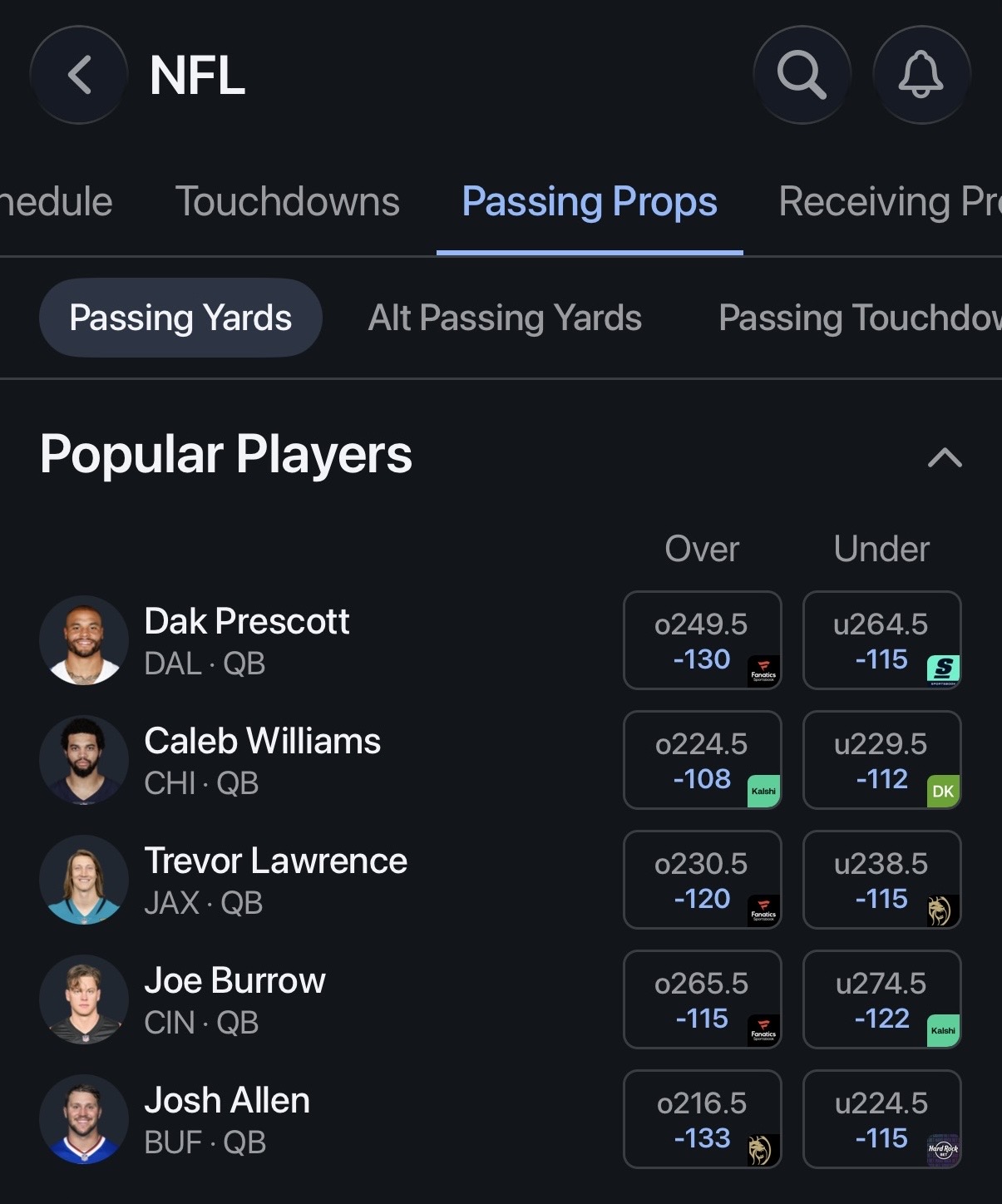
Passing props cover quarterback output: passing yards, completions, passing touchdowns, and interceptions. Passing yards is the most common, usually set between 200 and 300 yards for a starter. A passing-touchdown prop is often an over/under at 1.5 or 2.5, and a passing-TD yes/no can appear for specific players.
Find Passing props under NFL → Passing Props in the Pikkit App:
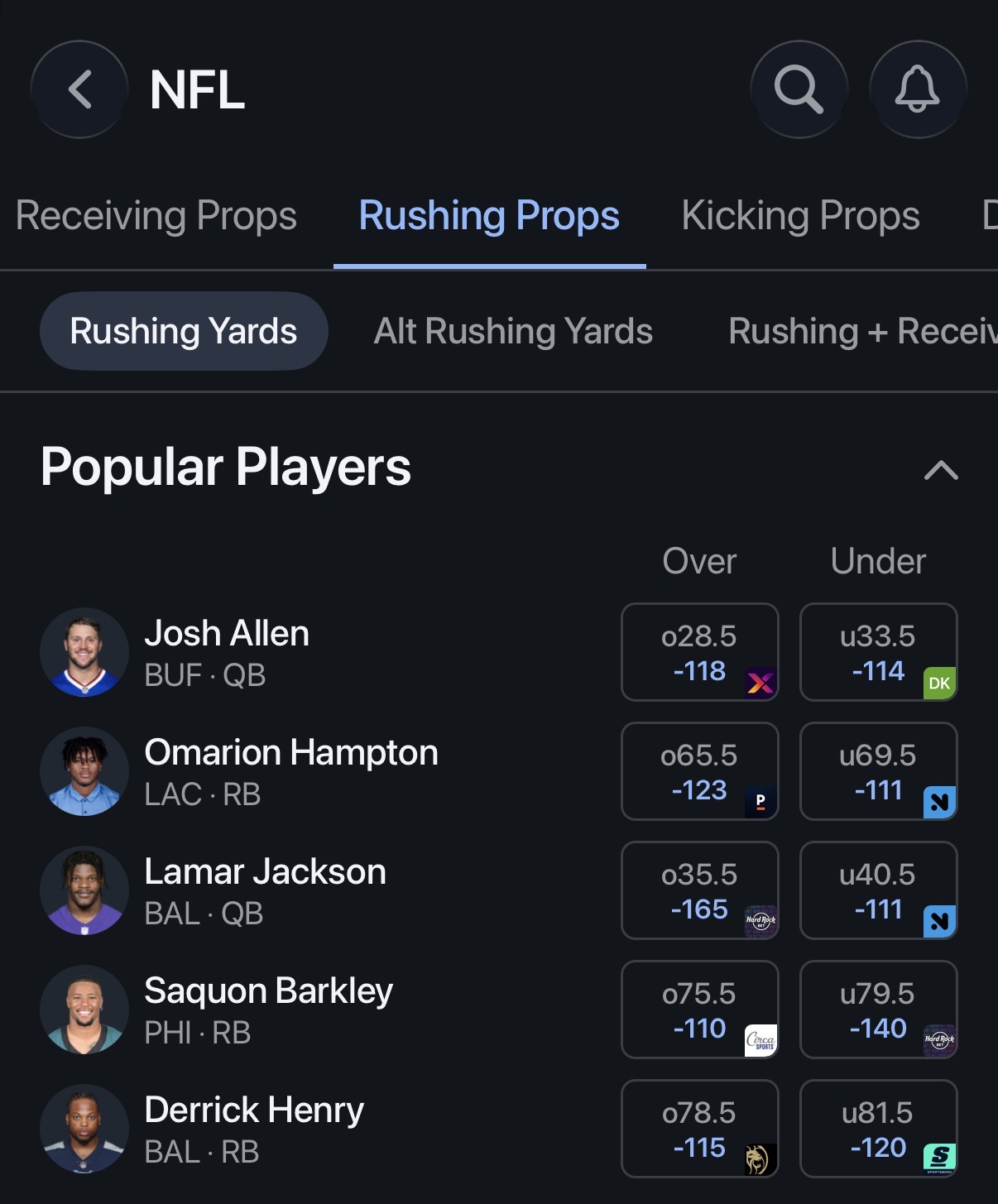
Rushing props cover rush attempts and rushing yards, most often for running backs but also for mobile quarterbacks. A workhorse back might sit at 78.5 rushing yards while a committee back sits at 42.5. Rushing attempts props are useful because volume is more predictable than efficiency.
Find Rushing props under NFL → Rushing Props in the Pikkit App:
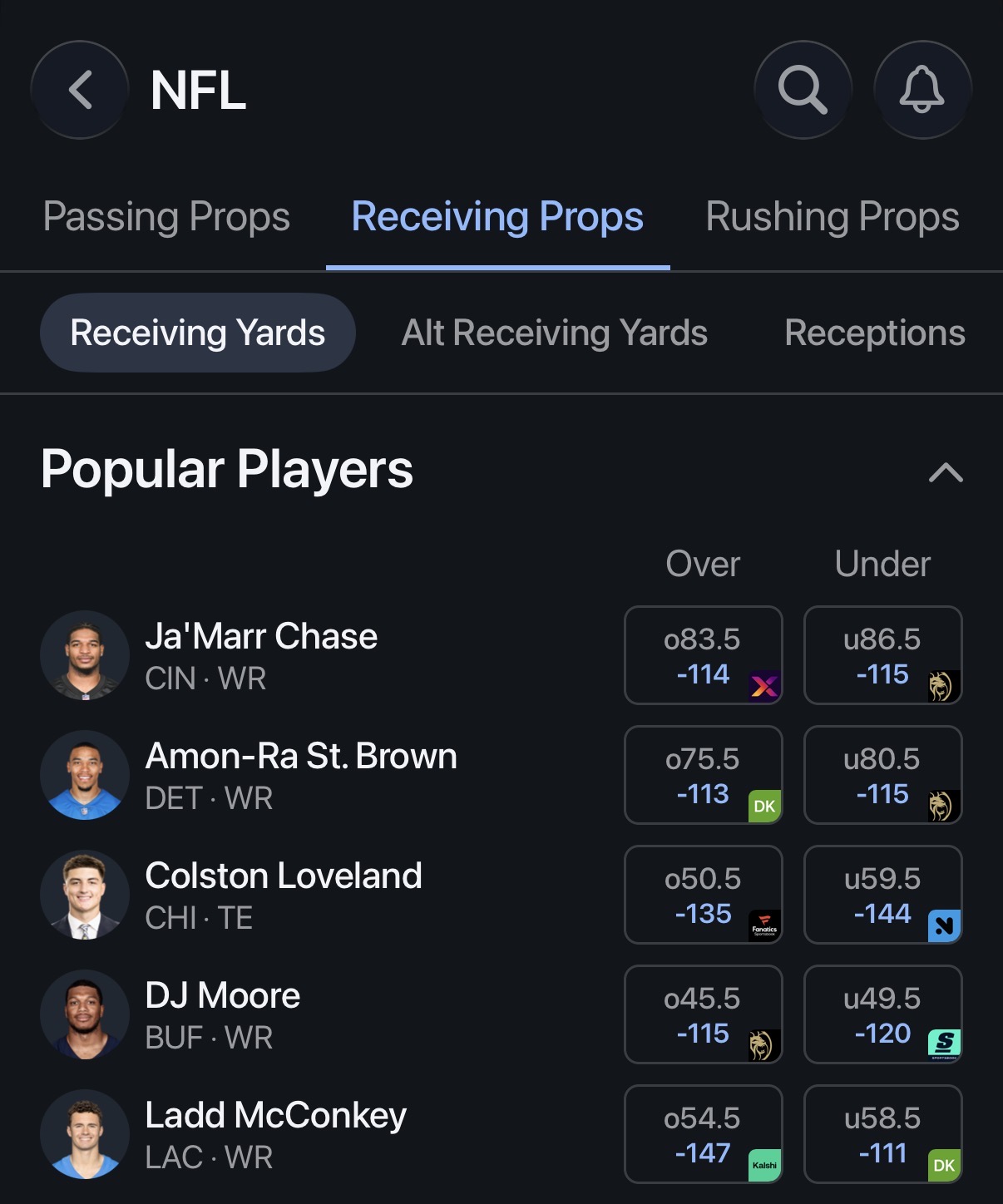
Receiving props cover receptions, receiving yards, and sometimes longest reception. A number-one receiver might be set at 5.5 receptions and 72.5 receiving yards, while a slot option sits lower. Receiving yards is the single most line-shopped prop in football because it swings hard on one or two plays.
Find Receiving props under NFL → Receiving Props in the Pikkit App:
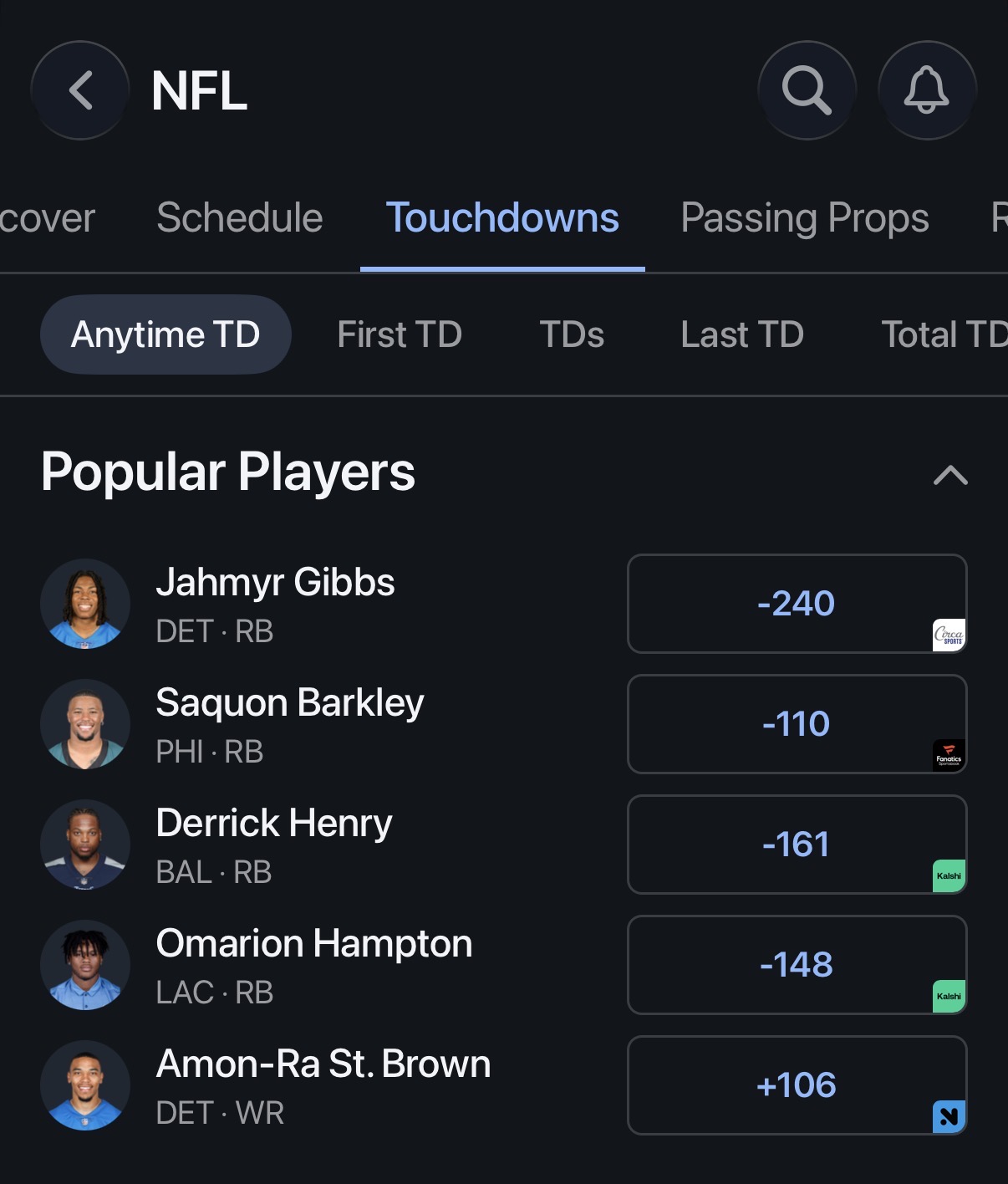
Touchdown scorer props ask whether a player finds the end zone. Anytime touchdown scorer is the most popular and pays close to even money for a lead back. First touchdown scorer and last touchdown scorer pay far more because they are harder to hit. One thing to watch: a quarterback touchdown-scorer prop usually means a rushing or receiving score, not a passing one. If your quarterback throws three touchdowns but does not run one in, an anytime-TD prop on him grades as a loss.
Find Touchdown scorer props under NFL → Touchdowns in the PIkkit App:
Not every prop is about a single player. Game props and team props zoom out to the game itself without asking who wins outright.
Common game props include first team to score, whether the game goes to overtime, the highest-scoring quarter, and the first scoring method (touchdown, field goal, or safety). Team props narrow the total to one side, such as "Bills team total over 24.5," which cashes if Buffalo alone scores 25 or more no matter what the other team does.
These markets often correlate with the main spread and total. If you already like a game to go over its total, the passing and touchdown props for that game lean the same direction. That connection is the backbone of same-game parlays, and it is also why stacking correlated overs is riskier than it looks. Our breakdown of prop bets in general covers how that correlation works across sports.
Props are priced in American odds, the same format as the rest of the board. A negative number is the side you have to lay money on, and a positive number is the side that pays a premium.
Most over/under props are priced near -110 on one or both sides. At -110 you risk $11 to win $10, or $110 to win $100. That extra juice is the sportsbook's margin, and on props it is often steeper than the -110 you see on spreads and totals. It is common to see a prop set at -120 on both sides, which is a heavier tax than the main markets carry.
Here is the math on a standard prop. Say you bet $55 on Ja'Marr Chase over 71.5 receiving yards at -110. If it hits, your profit is ($55 / 110) × 100 = $50, for a $105 return. A yes/no prop works the same way. A $50 bet on an anytime touchdown scorer at +130 returns ($50 × 130) / 100 = $65 in profit, for a $115 payout.
The reason the juice matters is your break-even rate. At -110, you need to win about 52.4% of the time just to stay even. At -120 that climbs to roughly 54.5%. Props carry more vig than the spread, so the number you have to clear is higher, which is exactly why getting the best available line does more work here than on any other bet type.
Put it together with a full example. Suppose it is Sunday and you are looking at the Bengals at the Ravens. The board shows:
Joe Burrow passing yards: 262.5, Over -115 / Under -105. You need 263 passing yards for the over to cash. The under is slightly cheaper at -105, which tells you the book is leaning a hair toward the over.
Lamar Jackson rushing yards: 48.5, Over -110 / Under -110. A clean coin-flip price. The book has no strong lean, so this is where your read on game script matters most.
Ja'Marr Chase anytime touchdown: +140. A $50 bet returns $70 in profit if he scores at any point. The plus price says the book gives him a bit under a coin-flip chance to find the end zone.
Reading a prop is really two steps. First, decide what you actually expect the stat to be. Second, compare that to the number and price the book is offering. If you project Burrow for 285 yards and the line is 262.5, the over has value. If you project him for 250, the under does. The bet is not "do I like Burrow," it is "is the number wrong."
Prop lines move slower and vary more than the main markets, which is where the openings show up. A few things drive that.
Usage and role changes. Player props are tied to opportunity. When a starting running back is ruled out, the backup inherits carries and his rushing prop should jump. When a top receiver is inactive, targets funnel to the next options. Reading the inactives list before kickoff is the single most useful habit in NFL prop betting.
Best for: bettors who track depth charts and injury reports and can act before the line catches up.
Watch for: confirming a player is actually active. A prop on an inactive player is usually voided, but a limited or questionable player who plays a reduced snap count can quietly sink an over.
Weather and game script. Wind and cold suppress passing yards and push games toward the run and the under. A team playing from behind throws more, which lifts passing and receiving props and cuts into rushing volume. A team protecting a lead does the opposite.
Best for: games with a clear weather story or a likely blowout script you can lean on.
Watch for: overreacting to weather. A 10 mph breeze is not a monsoon, and books already bake obvious conditions into the number.
Slow-moving lines. When news breaks, the spread adjusts in minutes but the related props can lag. If a starting quarterback is downgraded, his pass-catchers' receiving props may not move for a while, which creates a short window before the market corrects.
Line shopping matters more on props than on any other NFL bet. The same receiving-yards prop can sit at 65.5 on one book and 68.5 on another. That 3-yard gap decides the bet when the player finishes with 67. If you like the over, you want the lowest number. If you like the under, you want the highest. Same read, different result depending on where you place it.
Checking several apps by hand before every prop is tedious, which is where syncing your books helps. Pikkit's BookSync pulls the prop odds from your synced sportsbooks into one view so you can spot the best number before you bet instead of toggling between apps.
Tracking matters just as much after the bet. Props spread your action across dozens of small markets, so it is easy to lose the thread on what is actually working. Pikkit's bet tracker records every synced bet and breaks your results down by market, so you can see whether your receiving-yards overs are carrying you while your touchdown-scorer props quietly leak. Pairing that with closing line value tells you whether you are consistently beating the number the market settles on, which is the clearest signal that your prop reads are sharp even before the results catch up.
Read the line, project the stat yourself, take the best available number, and keep a record of what hits. That is the whole game with NFL props.
Download Pikkit to track every NFL prop across all your sportsbooks in one place.
An NFL prop bet, short for proposition bet, is a wager on a specific event within a game rather than the final score. Player props cover individual stats like passing yards or touchdowns, and game props cover events like the first team to score or whether the game reaches overtime. The result of the prop does not depend on who wins the game, only on the specific event you bet.
Passing yards, rushing yards, receiving yards, and anytime touchdown scorer are the four most popular NFL player props. Passing yards and receiving yards are over/under markets, while anytime touchdown scorer is a yes/no market that pays if the player scores at any point. Receiving-yards props see the most line variance across sportsbooks, which makes them a common target for line shopping.
NFL props are priced in American odds, usually near -110 on over/under markets, meaning you risk $110 to win $100. Yes/no props can carry plus-money prices when the event is less likely, such as +140 on an anytime touchdown scorer. Props often carry more juice than spreads and totals, so your break-even win rate is higher and getting the best price matters more.
Props are not inherently harder, but they usually carry more vig than the spread or total, which raises the win rate you need to break even. The trade-off is that prop lines move slower and vary more between sportsbooks, so a bettor who follows usage and shops for the best number can find value that the main markets rarely offer.
A single NFL game can have 50 or more player props, and sportsbooks put most of their attention on the high-volume spread and total. That leaves prop lines less closely managed, so the same player's receiving yards might be 65.5 at one book and 68.5 at another. Those gaps are the reason line shopping is more valuable on props than on any other NFL market.
Usually not. An anytime touchdown scorer prop on a quarterback typically requires a rushing or receiving touchdown, not a passing one. If your quarterback throws for three scores but does not run one in, the anytime-TD prop grades as a loss. Passing touchdowns have their own separate prop market, so read the label before you bet.
Props are posted earlier in the week than most in-game markets, which gives you time to study matchups and depth charts. The sharpest window is often right after the inactives are announced about 90 minutes before kickoff, when role changes are confirmed but the lines have not fully adjusted. Confirm your player is active, compare the number across books, and place the bet at the best available price.


