


Hedging a bet means placing a second bet against your original one to lock in a profit or limit a loss, no matter how the game ends. You give up some upside in exchange for certainty. The most common hedge is on a futures bet or parlay that's still alive late.
A hedge is a bet on the opposite outcome of a position you already hold. Say you bet $100 on Team A to win the title at +2000 before the season. Team A makes the final, where they're +150 and Team B is -150. If Team A wins, you profit $2,000. If they lose, you're out $100. A hedge on Team B lets you guarantee money either way.
1. Find your total payout. Your $100 at +2000 returns $2,100 if it wins.
2. Get the best price on the other side. Shop the hedge line across your books. Every bit of vig you avoid is money you keep. Line shopping makes this easy.
3. Pick your hedge size. To lock in the same profit on both outcomes, divide your total payout by the hedge's decimal odds. Team B at -150 is 1.67 in decimal odds, so a full hedge is $2,100 ÷ 1.67, or about $1,260.
4. Place the hedge. With $1,260 on Team B, you profit about $740 whichever team wins.
The math gets harder with multiple tickets, live odds or partial hedges. Pikkit Pro's hedge calculator tells you exactly how much to bet on any hedgeable bet.
Using the same $100 ticket and Team B at -150:
Full hedge ($1,260 on Team B): profit $740 either way. All the risk is gone, and so is the upside.
Breakeven hedge ($150 on Team B): if Team A wins, you profit $1,850. If Team B wins, you break even at $0. You can't lose money, and you keep almost all of your upside.
Partial hedge ($630, half the full hedge): if Team A wins, you profit $1,370. If Team B wins, you profit $320. It's a middle ground between protection and upside.
Middling: betting both sides of a spread or total at different numbers, hoping the result lands between them so both bets win.
Live hedging: hedging during the game as the odds move, often on a bet that's ahead late or a parlay down to its last leg.
Usually, yes, a little. Every hedge is a new bet, and each one carries the sportsbook's vig. In the example, Team B at -150 implies a 60% chance. Suppose Team A's true chance is 42%, so Team B's is 58%.
No hedge: expected value is about +$782.
Breakeven hedge: about +$777, costing $5.
Half hedge: about +$761, costing $21.
Full hedge: a guaranteed $740, costing $42.
The bigger the hedge, the more vig you pay for certainty. Better hedge prices shrink that cost, and hedging with free bets or promos costs little to nothing in EV.
But EV isn't the whole story. When one ticket is a big share of your bankroll, a hedge can raise your expected bankroll growth even while it costs a little EV. Long-term bankroll growth is what Kelly-style bettors try to maximize, so a smart hedge can be the right move and not just a nervous one. Dan Abrams walks through the math in The Coin Flip Challenge on Pinnacle, and he covers it in his book, But How Much Did You Lose?
The payout would change your life. If a ticket's payout would meaningfully affect your finances, locking in a guaranteed profit is a rational choice even though it costs EV.
Too much of your bankroll is riding on one result. Hedging cuts your variance. See our bankroll management guide.
You can hedge with free bets or promos. A bonus bet on the other side reduces risk at almost no cost.
The situation changed. An injury or new information makes your original side less likely than the odds say.
You're nervous, not losing your edge. If the stake fits your normal bankroll, nerves aren't a reason to give up EV.
The hedge price is bad. Heavy juice on the other side makes certainty expensive.
The stakes are small. If hedging only changes the outcome by a few dollars, let it ride.
With several tickets in the same market, some of your risk is already spread out. Work out your profit for every outcome, including the one where none of your tickets hit, then hedge the outcomes that hurt you most. Scenario Analysis in Pikkit shows your payout for every outcome in a market where you hold more than one position.
Here's a real bet from a Pikkit user: $10 on the Spurs to miss the 2026-27 NBA playoffs at +12500, paying $1,250. The other side, Spurs to make the playoffs, is -10000.
Full hedge ($1,247.52 on "Yes"): a guaranteed $2.48 profit no matter what. You'd risk $1,247 to lock in less than three dollars.
Breakeven hedge ($1,000): $0 if the Spurs make it, $250 if they miss. You can't lose money, and you keep real upside.
Custom or partial hedges: anything in between, like $500 or the 75% option at $935.
When the hedge side is priced this heavily, a full hedge barely beats doing nothing. Seeing every option side by side, with your profit for each result, is how you pick the one that fits.
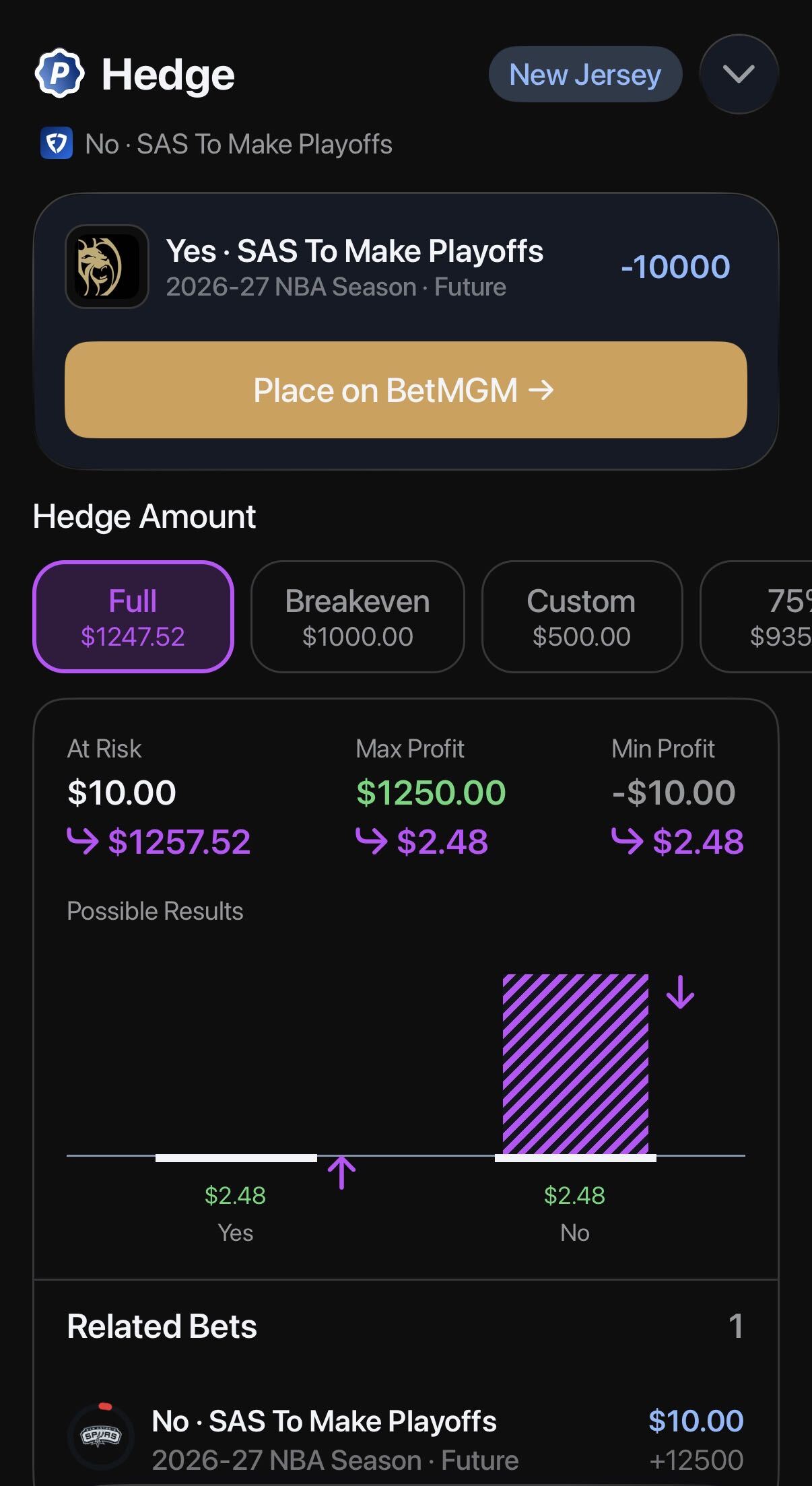
Pikkit Pro includes a hedge calculator that tells you exactly how much to bet to hedge.
Hedge options: pick a full hedge, breakeven, 75%, 50% or 25%, or enter a custom amount for the hedge side.
Every result in one view: see your amount at risk, max profit and min profit before and after the hedge, plus your profit for each possible result.
Place it in one tap: the calculator shows the hedge line and a button to place it at the sportsbook.
Hedge opportunity alerts: turn on notifications to know when a bet becomes worth hedging.
Find it fast: it's on your Summary page, in the Pro Center, and on any bet that can be hedged.
Because Pikkit syncs your sportsbooks through BookSync, your open bets are already in the app, so there's nothing to type in.
It depends on your stake, bankroll and the hedge price. Hedging usually costs a little expected value, so it's worth it when the certainty matters more to you than the EV you give up.
Yes, once it's down to its last leg. Bet the opposite side of the final leg to lock in a profit. Pikkit Pro's hedge calculator works out the amount for you.
Yes. Hedging is just placing another bet, and you can do it at the same book or a different one.
A tool that tells you how much to bet on the other side to lock in a profit or break even. Pikkit Pro has one built in.
Yes. It's a Pikkit Pro feature with full, breakeven, 75%, 50%, 25% and custom hedge options, plus alerts for hedge opportunities.
21+. Gambling problem? Call 1-800-GAMBLER.


