.png)


Parlays are the most popular bet type in sports betting. Parlays are also the most profitable market for sportsbooks. That's not a coincidence. The juice on parlays compounds with every leg you add, and sportsbooks know that most bettors never look at their actual parlay results.
In New Jersey alone, sportsbooks have held nearly 20% on parlays in recent reporting periods. Compare that to the roughly 4.5% hold on standard spread bets at -110. The gap is huge and invisible to most bettors who aren't tracking.
A parlay tracker changes that. It shows you exactly what your parlay betting is doing to your bankroll. Not what it feels like, but what the numbers actually say.
Most bettors remember their parlay wins vividly. A 4-leg parlay that hit for +1100? You remember the payout, the games, maybe even the exact moment the last leg cashed. But the 15 parlays that lost before it? Those fade into the background.
This is why parlays are dangerous without a tracker. The wins are dramatic enough to create a false sense of profitability. Meanwhile, the cumulative losses add up quietly.
Here's a scenario most parlay bettors have lived through: you hit a 3-leg parlay for $220 on a $10 bet. Great night. But over the previous two weeks, you placed thirty 3-leg parlays at $10 each. That's $300 in total wagers and lost every one. That $220 win felt like a hot streak, but your actual ROI across those parlays is -26%.
Without a tracker, you'd never do that math. With one, it's automatic.
Tracking your parlays separately from your straight bets reveals patterns that change how you bet.
ROI is the only number that matters for evaluating your parlay strategy. Win rate is misleading for parlays because the odds vary so much. A bettor hitting 25% of their 3-leg parlays at +600 is in a very different spot than someone hitting 25% of their 2-leg parlays at +260.
ROI tells you how much you're actually making (or losing) per dollar wagered on parlays. Most bettors who track their parlays for the first time are surprised by how negative that number is compared to their straight bet ROI.
Are your 2-leg parlays profitable but your 4-leg parlays are draining your bankroll? You won't know until you track them separately. The juice compounds with each leg of a parlay. A 2-leg parlay at -110 carries about 9% in built-in juice, while a 4-leg parlay compounds that to roughly 17%. The more legs you add, the harder it is to overcome the math.
Tracking by parlay size lets you see exactly where the cutoff is for your betting style. Many bettors find their 2-leg parlays are close to break-even while everything above 3 legs is a consistent loss.
Same-game parlays (SGPs) and multi-game parlays are fundamentally different bets, and your tracker should separate them.
SGPs involve correlated outcomes. For example, if you think a game will be high-scoring, the passing yards over and the touchdown props are more likely to hit together. Sportsbooks know this and adjust the odds to account for correlation, but they don't always price it perfectly. Some bettors find edges in SGPs that don't exist in multi-game parlays.
Multi-game parlays combine independent outcomes. Each leg is its own analysis with no correlation to the others. The risk is purely mathematical. You're compounding the probability of multiple independent events all going your way.
Tracking both types separately tells you whether one is working and the other isn't.
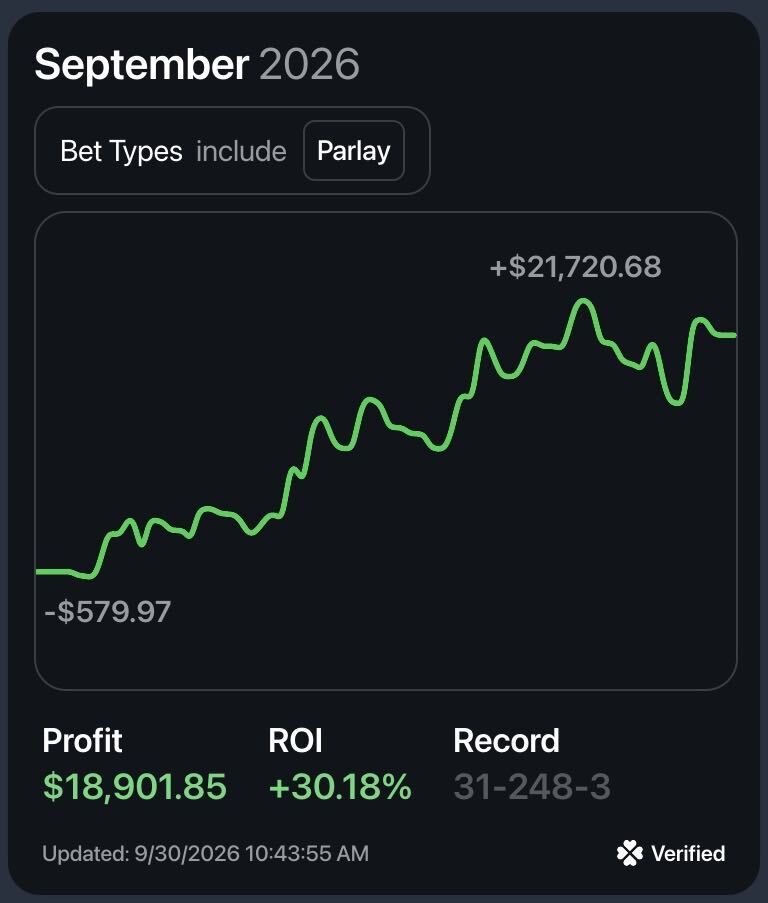
Your NFL player prop parlays might be profitable while your NBA spread parlays are losing money. Or maybe you're sharp on 2-leg MLB totals but losing on everything else. A parlay tracker broken down by sport and bet type shows you exactly where your edge is and where it isn't.
This matters more than most bettors realize. If your data shows a 12% ROI on NFL prop parlays but -8% on NBA spread parlays, the answer isn't to bet more parlays. It's to bet more NFL prop parlays and stop the NBA ones.
You might already track your bets. But if your tracker lumps parlays in with straight bets, you're missing half the picture.
Parlays need their own lens because the economics are different. A $100 straight bet at -110 and a $100 4-leg parlay have completely different risk profiles, expected returns, and juice costs. Blending them into one ROI number hides the truth about both.
Good parlay tracking means seeing your results filtered by:
When you can slice your parlay data this way, you stop guessing and start making decisions based on evidence.
Closing line value (CLV) is the gold standard for evaluating straight bets. The same principle applies to parlays. Pikkit Pro alculates CLV on your parlays as a whole whenever Pikkit has odds for the market, so you can see whether your parlays consistently beat the closing line. Same-game parlays don't get a CLV.
If your parlays consistently show positive CLV, your process is likely sound even through losing streaks. If they show negative CLV, adding more legs won't fix the problem. Each leg you add compounds the price you're paying.
Only tracking wins. Screenshotting winning tickets and ignoring the losses isn't tracking. It's highlight-reel thinking. A real tracker captures every parlay, win or loss, automatically.
Not separating parlays from straight bets. A blended ROI across all bet types hides your parlay performance. If your straight bets are profitable but your parlays are dragging you down, you need to see that clearly.
Ignoring total outlay. Bettors focus on the potential payout of a parlay but don't track how much they're spending on parlays per week. If you're placing ten $20 parlays every Sunday, that's $200 in weekly parlay exposure. Track the total spend, not just the individual bets.
No sample size awareness. Parlays have high variance. A 2-leg parlay at +260 only needs to hit about 28% of the time to break even, but you might go 0-for-10 before hitting a streak. You need at least 100+ tracked parlays before drawing conclusions about your parlay strategy.
The simplest approach: use a tracker that does it automatically.
Pikkit's BookSync imports your bets from 30+ sportsbooks including parlays with full leg detail. Every parlay you place gets logged with the individual legs, odds, stake, and result. You can then filter your performance by bet type, sport, leg count, and sportsbook to see exactly how your parlays are performing.
No spreadsheets, no manual entry, no forgetting to log the ones that lost. Your parlay data is complete because it syncs directly from your sportsbook accounts.
If your parlay ROI is negative and your straight bet ROI is positive, that's a signal worth paying attention to. If certain parlay types are working and others aren't, adjust accordingly. The data is only useful if you actually have it and a parlay tracker makes sure you do.
A parlay tracker is a tool that records and analyzes your parlay bets. That includes individual legs, odds, stakes, and results. It calculates your parlay ROI, win rate, and performance by sport, leg count, and sportsbook so you can see whether your parlays are actually profitable.
At least 100, ideally more. Parlays have high variance because of the compounding odds, so small samples are mostly noise. A 10-parlay winning streak doesn't prove your strategy works, and a 10-parlay losing streak doesn't prove it's broken.
Not necessarily. Look deeper at the data first. Your 2-leg parlays might be profitable while your 5-leg parlays are dragging down the overall number. Or your NFL parlays might be strong while your NBA parlays are losing. A tracker lets you cut what's not working and keep what is.
Yes. Pikkit logs SGPs with full leg detail through BookSync, so you can see your SGP performance independently from your multi-game parlay results.
A parlay tracker is a feature within a bet tracker. The key difference is whether the tracker breaks out parlays with adequate detail. That includes leg-level data, ROI by leg count, SGP vs. multi-game splits. A tracker that just logs "parlay, $40, lost" without the leg detail isn't giving you enough to work with.
Anything consistently positive is strong, given that sportsbooks hold 15-20% on parlays across the market. A 0% to -5% parlay ROI means you're significantly outperforming the average bettor. If you're seeing +5% or better on parlays over a large sample, your process is working.


