.png)


Closing line value (CLV) measures whether the odds you got on a bet were better than the final odds before kickoff. Beating the closing line consistently is one of the clearest indicators of long-term betting profitability. For a deeper foundational explanation, see our guide on what closing line value is.
The basic CLV calculation compares your bet odds to the closing odds. There are two common approaches:
Simple CLV (line movement)
This is the most straightforward method. You compare the spread or total you bet to where the line closed.
You bet: Chiefs -2.5 (-110)
Closing line: Chiefs -4.5 (-110)
You got two points of CLV. Over hundreds of bets, those points compound into real profit.
Odds-based CLV (implied probability)
For a more precise measurement, convert both your bet odds and the closing odds to implied probabilities, then compare.
You bet: Moneyline at +150 (implied probability: 40%)
Closing line: +130 (implied probability: 43.5%)
Your CLV = 43.5% - 40% = +3.5%
You locked in a price that implied a 40% chance of winning, but the market's final assessment was 43.5%. That gap is your edge.
The odds-based method works across all bet types and accounts for movement in the vig, making it more accurate than just tracking line movement.
Vig-Free CLV
For a purer measurement, strip the sportsbook's margin out before comparing. Convert both your bet odds and the closing odds to implied probabilities, then normalize each side so they add up to 100% instead of the inflated total books build in.
You bet: -110 (implied probability: 52.4%) Closing line: -115 (implied probability: 53.5%) Overround: 105.9%
After removing the vig, your true implied probability was 49.5% and the closing probability was 50.5%. The difference is your vig-free CLV.
This method removes the sportsbook's built-in edge from the equation, giving you a cleaner read on whether you actually beat the market. Pikkit Pro does this automatically when you choose No-Vig Fair Odds in your CLV Preferences.
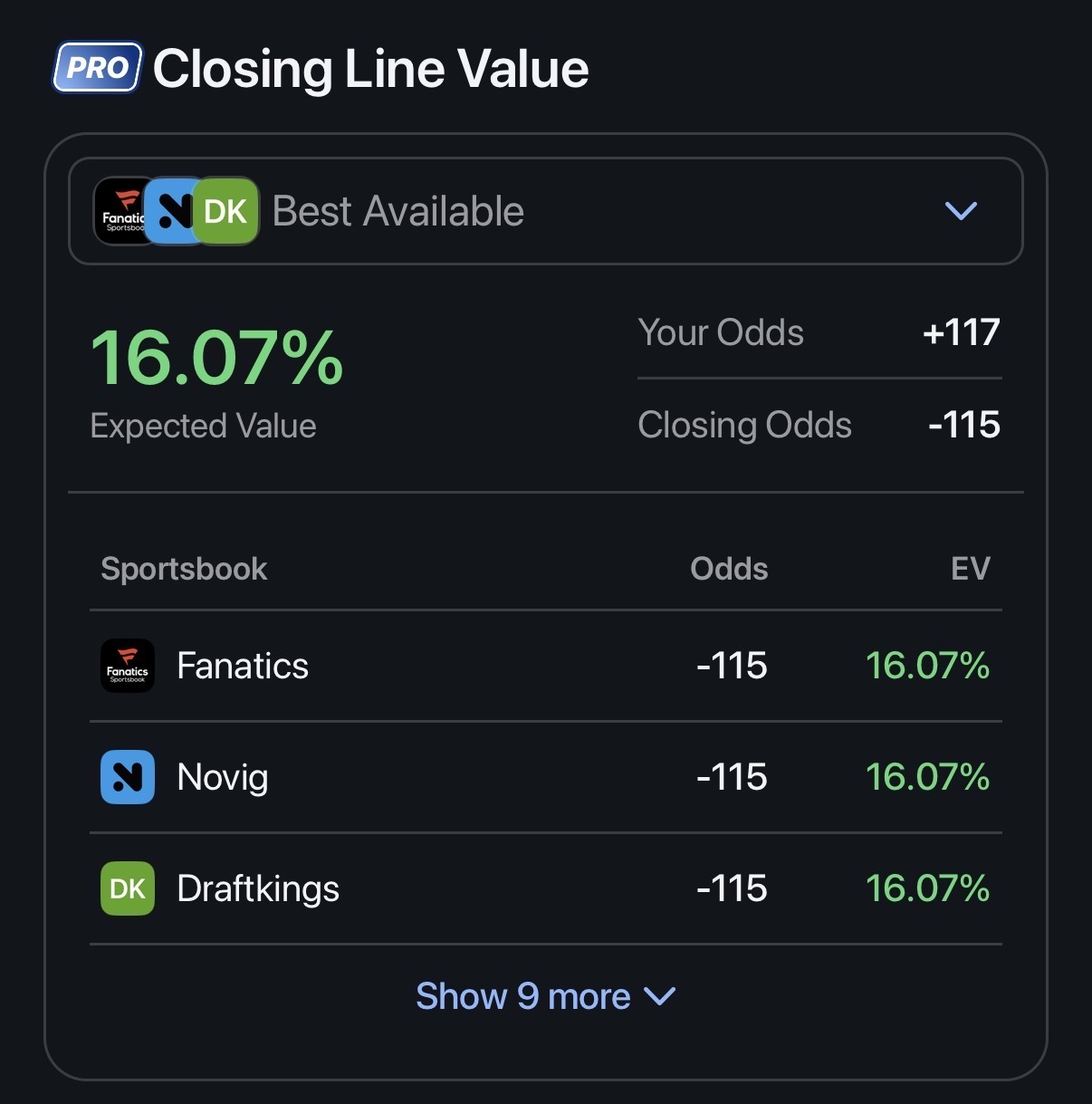
The Manual Way
You can track CLV yourself by recording the odds you bet at, then checking the closing line right before game time and logging the difference. This works in theory but breaks down quickly in practice. If you're placing five or ten bets a day across multiple sportsbooks, manually checking and recording closing lines for each one is tedious. You'll miss games, forget to check, or just stop doing it after a week.
The Spreadsheet Way
A step up from fully manual tracking. You log your bets in a spreadsheet and add columns for closing odds. Some bettors pull closing lines from sites that archive them and update their sheets after the fact. This is more accurate than the manual approach, but it's still labor-intensive. The odds data has to come from somewhere, and updating a spreadsheet with closing lines for every bet takes real time.
The Automated Way
A CLV tracker that does the work for you. You place your bets normally, and the tracker records your odds, captures the closing line, and calculates CLV automatically for every bet.
This is what Pikkit Pro does. Straight bets, props, and parlays synced through BookSync have their CLV calculated automatically whenever Pikkit has odds for the market. You don't log anything or look up closing lines. Pikkit compares your locked-in odds against the closing line and tells you whether you beat it.
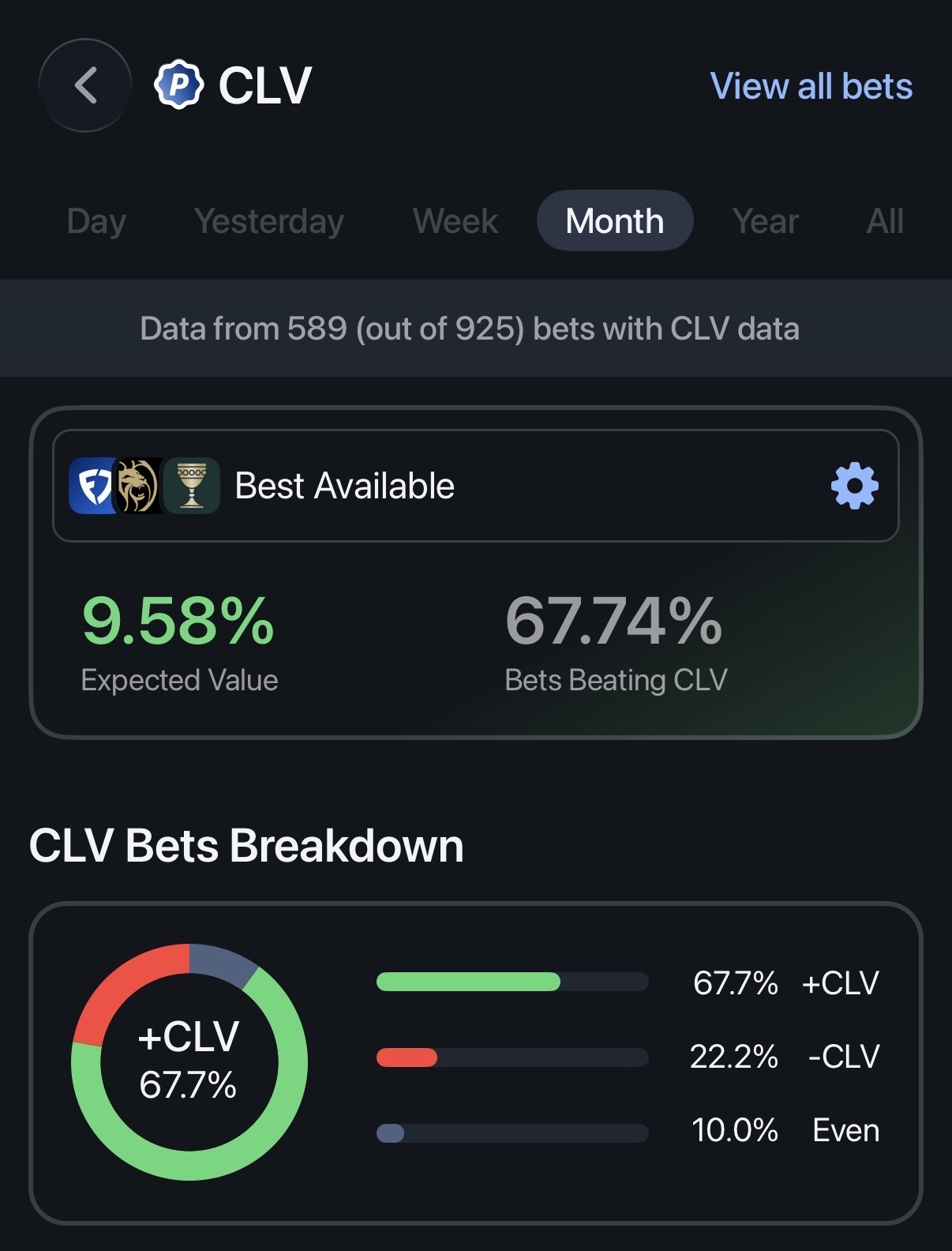
Beyond individual bets, Pikkit Pro shows you your CLV analytics in three ways: your aggregated CLV stats over any time period, your expected profit broken down by sportsbook, league, and sport, and the percentage of your bets beating CLV ranked by category. That last one is especially useful as it tells you exactly where your edge is strongest.
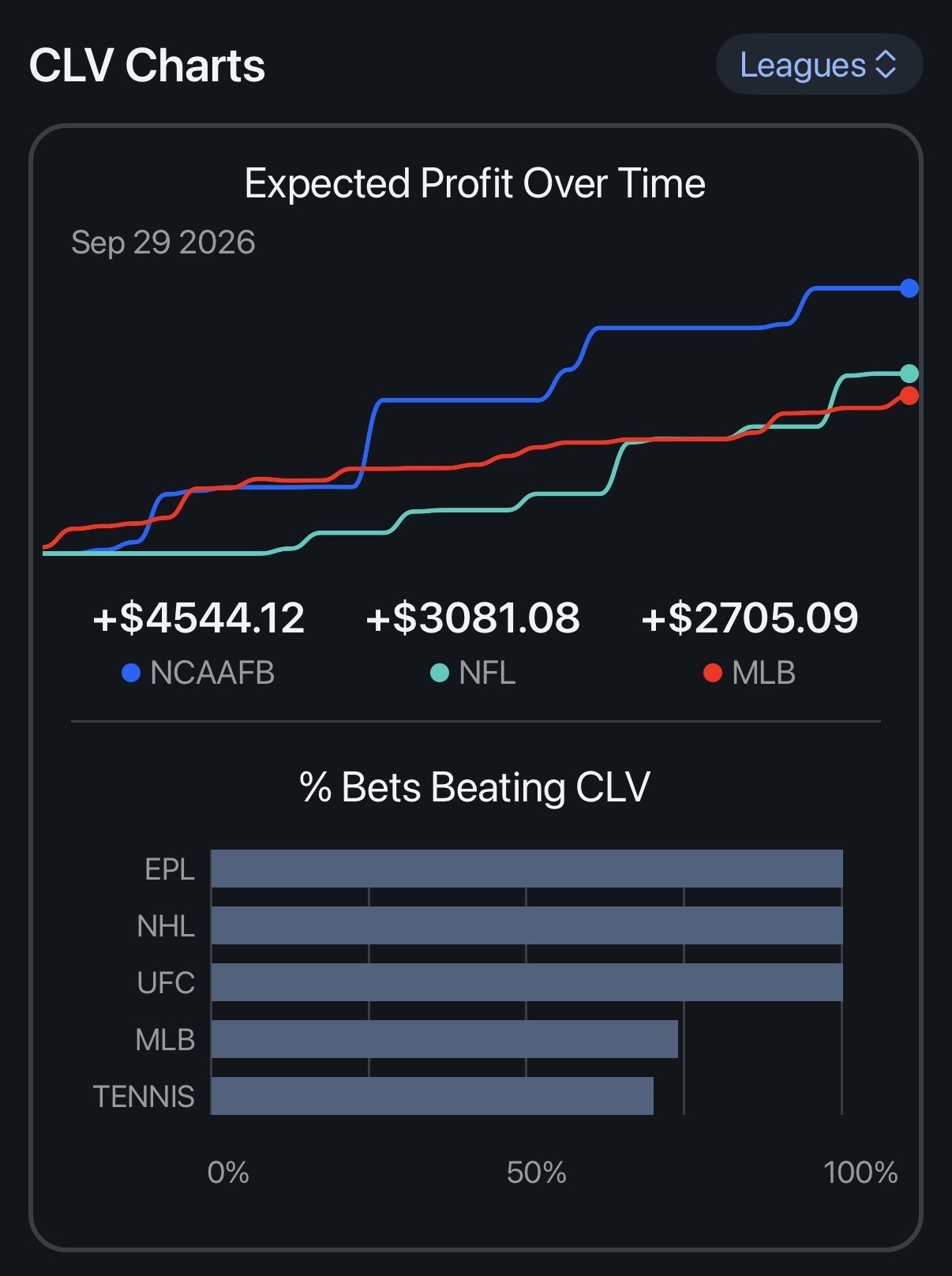
There's no magic number, but here are some general benchmarks:
Above 60-65% of bets beating CLV over a sample of 200+ bets in a market suggests you're consistently finding value. The market is moving toward your number after you bet, which means you're getting in early on the right side.
Around 50% means you're roughly in line with the market. You're not finding edge, but you're not getting consistently bad numbers either.
Below 45% over a meaningful sample is a warning sign. The market is consistently settling on better numbers than what you locked in, which means you're likely betting too late or on the wrong side of line movement.
The key word in all of this is "sample size." A week of bets means nothing. A full season of tracked bets with CLV data gives you something real to work with.
Once you're tracking CLV, you can start making adjustments to improve it.
Bet earlier. Lines tend to sharpen as game time approaches. The earlier you lock in a number after the line opens, the more likely you are to beat the closing line. Especially if sharp money moves the line in your direction after you bet.
Shop lines across sportsbooks. Different books hang different numbers. If one book has Chiefs -3 and another has Chiefs -3.5, taking the -3 gives you a better shot at positive CLV. This is where having accounts at multiple sportsbooks and a tool that shows you odds across books pays off.
Focus on where your CLV is strongest. If your CLV data shows you're consistently beating the closing line on NFL spreads but not on NBA totals, lean into what's working. Your edge might be sport-specific or bet-type-specific, and CLV data reveals that.
Avoid chasing steam moves. If a line has already moved significantly, the value may already be gone. Bettors who jump on a line after it's moved from -3 to -5 are often buying at the worst possible price and ending up with negative CLV.
Pikkit Pro calculates CLV on straight bets, props, and parlays whenever Pikkit has odds for the market. You choose what your odds are compared against in CLV Preferences: Best Available (the default), No-Vig Fair Odds, Custom Book Selection, or Respective Sportsbook. See how each option works on our CLV page.
You bet the Chiefs moneyline at -110 on FanDuel. That's an implied probability of 52.4%. Your preferred sportsbooks are FanDuel, DraftKings, and BetMGM.
At kickoff, the Chiefs closed at:
FanDuel: -122 (55.0%)
DraftKings: -125 (55.6%), with the other side at +105
BetMGM: -118 (54.1%)
Here's your CLV under each method:
Best Available: +1.7%. The best closing price across your books was BetMGM's -118 (54.1%). 54.1% minus 52.4% is +1.7%.
No-Vig Fair Odds: +0.9%. DraftKings' closing market (-125 / +105) adds up to 104.3%. Removing that juice puts the fair price at 53.3%, about -114. 53.3% minus 52.4% is +0.9%.
Custom Book Selection (DraftKings only): +3.2%. DraftKings closed at -125 (55.6%). 55.6% minus 52.4% is +3.2%.
Respective Sportsbook: +2.6%. You bet at FanDuel, which closed at -122 (55.0%). 55.0% minus 52.4% is +2.6%.
You beat the close under all four methods, but the size of your edge depends on the benchmark. No-Vig Fair Odds is the strictest because it strips out the juice every book builds in. Best Available is the strictest of the sportsbook benchmarks because it measures you against the best closing price anywhere. Pikkit Pro runs this math automatically on every eligible bet.
You can't improve what you don't measure. CLV gives you a clear, objective signal of whether your betting process is working, not just whether you got lucky this week.
If you're serious about understanding your edge, download Pikkit and try Pikkit Pro. BookSync imports your bets automatically and Pikkit Pro calculates CLV on your straight bets, props, and parlays whenever it has odds for the market. No spreadsheets or manual input, just the data you need to know if you're actually sharp.
What is closing line value in sports betting?
Closing line value (CLV) measures whether the odds you bet at were better than the final odds before the game started. Consistently beating the closing line is widely considered the best indicator of long-term betting skill.
How many bets do I need before CLV data is meaningful?
At least 200-300 tracked bets before drawing conclusions. Anything less and the sample is too small to separate skill from variance. A full season of tracked bets across multiple sports gives you the clearest picture.
Does positive CLV guarantee profit?
No. Positive CLV means your process is sound. You're consistently finding value before the market corrects. But short-term results can still swing negative due to variance. Over a large enough sample, positive CLV strongly correlates with profitability, but it's not a guarantee on any individual bet or week.
Can I track CLV on parlays and same-game parlays?
Yes for parlays, no for same-game parlays. Pikkit Pro calculates CLV on straight bets, props, and parlays whenever Pikkit has odds for the market. Parlays get one CLV for the whole bet. Same-game parlays and bets on markets Pikkit doesn't have odds for don't get a CLV.
What's the difference between CLV and expected value (EV)?
Expected value estimates whether a bet is profitable based on the probability of winning versus the odds offered. CLV measures whether you got a better price than the closing line. They're related but not the same. A bet can be +EV without having positive CLV, and vice versa. CLV is generally considered a more reliable long-term signal because the closing line reflects the market's sharpest assessment.

