.png)


Line shopping means comparing the same bet across multiple sportsbooks and placing it wherever the price is best. The bet is identical. The payout is not. One book might post a total at -110 while another has the same number at -105, and the second book pays you more for being right about the exact same outcome. Doing this on every bet is the single most reliable way to add value to your betting, and it requires no handicapping skill at all.
This guide covers what line shopping is, why it matters more than most people realize, the math behind a half-point of price, where it pays off most, and how to do it quickly enough to catch the best number before it moves.
Line shopping is the practice of checking the price on a bet at several sportsbooks and taking the best one. Sportsbooks set their own odds, and they do not all agree. The same Chiefs spread can be -110 at one book and -105 at another. The same game total can be 46.5 at one book and 47.5 at another. Each of those gaps is money, and line shopping is how you capture it.
The reason the gaps exist is that every book prices independently. They weigh injuries, betting volume, and their own risk differently, so their numbers drift apart. A bet is not one price. It is a range of prices across the market, and you decide which end of that range you are on.
Nothing about line shopping requires you to be a better handicapper. You are not changing your pick. You are only refusing to accept a worse price for it.
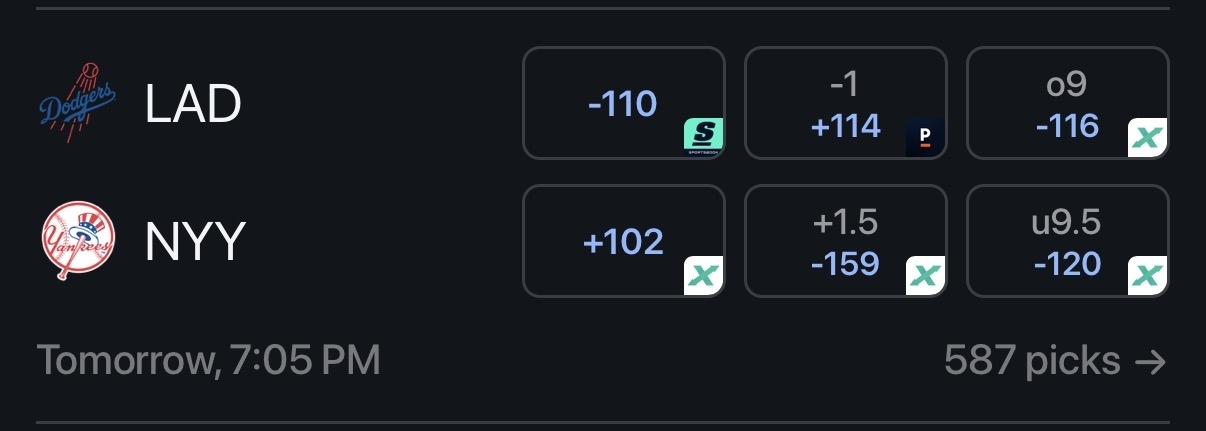
Take a peak at what an event card looks like on the Pikkit app:
Betting is a low-margin game. A bettor who wins 53% of spread bets at standard pricing is doing well, and the edge that separates a long-term winner from a long-term loser is thin. Line shopping widens that edge on every single bet without you having to be right more often.
The cost you are fighting is the vig, the margin a sportsbook builds into its prices. Standard -110 pricing on both sides of a spread means the book collects more than it pays out over time. Getting -105 instead of -110 shaves that margin directly. You are not beating your opponent's opinion. You are paying less for the same position.
The numbers back this up. Consistently taking the best available price is generally worth somewhere around 0.5% to 2% of added return over a large sample. That sounds small until you compare it to a realistic edge. If your betting produces a 4% return, an extra point or two from pricing alone is a large share of your total profit. It is the rare improvement that costs nothing and compounds on every bet you make.
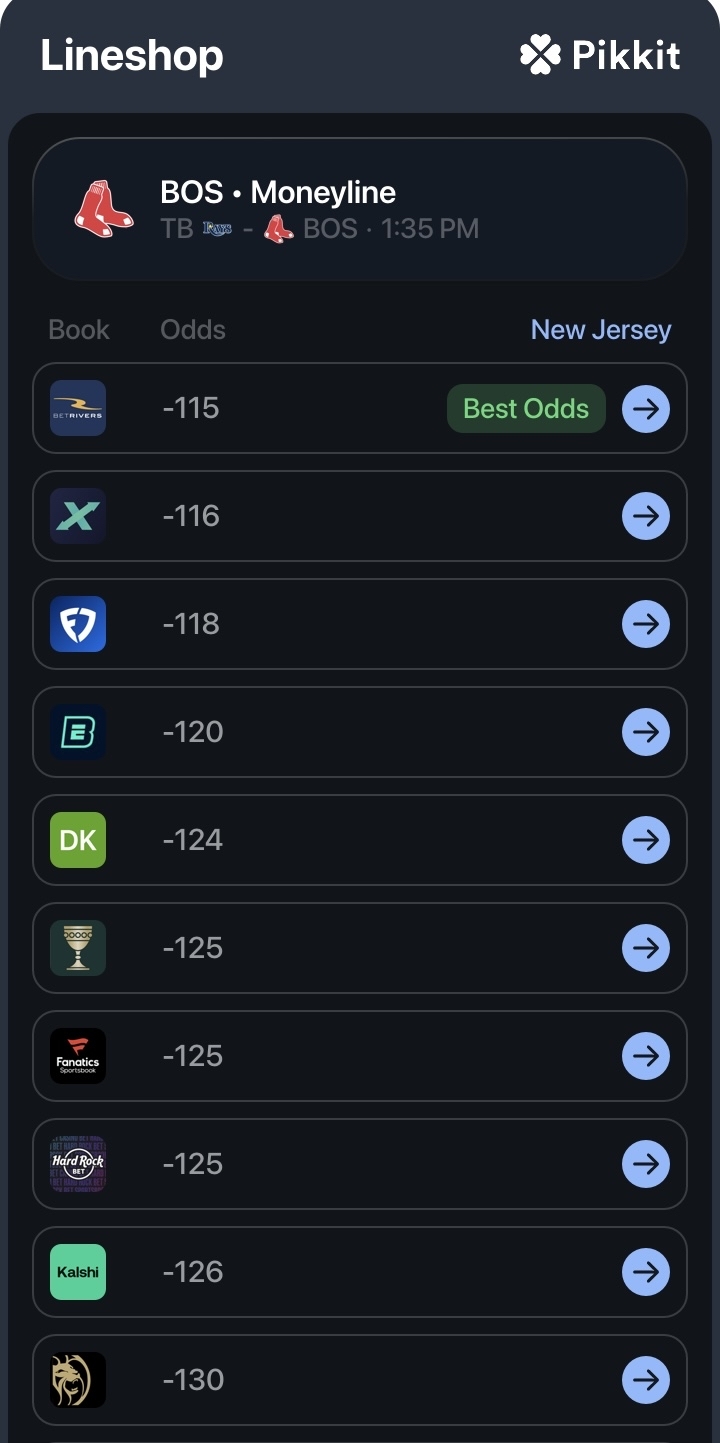
Below is an example of the price difference for the ML of a baseball game:
The clearest way to see the value is to price out a single bet two ways.
Say you want to bet a spread. At Book A it is -110, and at Book B the same spread is -105. To win $100 at Book A you risk $110. To win the same $100 at Book B you risk $105. That is $5 saved on a single bet for taking 30 seconds to check. Place 200 bets in a season at that gap and you have kept $1,000 that would otherwise have gone to the book, with no change to how often you win.
The price also moves your break-even point. A -110 bet has to win about 52.4% of the time just to break even. A -105 bet only has to win about 51.2%. Getting the better number lowers the bar your picks have to clear, which is the whole game. For the full breakdown of how American odds convert to implied probability, see our moneyline odds guide.
Totals and spreads add a second layer, because you can shop the number itself, not just the price. Suppose two books disagree on a game total, one at 46.5 and one at 47.5, and you like the over. Taking 46.5 means the game needs one fewer point to cash your bet. On a total that lands on 47 exactly, one book pays you and the other loses. That full point can be worth several percent of win probability on close games, which dwarfs the price difference. When you line shop, you are hunting for both the better number and the better price on it.
Line shopping helps on every bet, but the payoff is not evenly spread.
Totals (over/under): This is where shopping the number matters most. A one-point difference in a total is common across books, and on games that land near the number it decides the bet outright. Always check the total at multiple books before betting an over or under.
Point spreads around key numbers: In football, margins cluster on 3 and 7. Getting a spread of +3 instead of +2.5, or -2.5 instead of -3, can be the difference between a win, a push, and a loss on a huge share of games. The half-point matters far more near those key numbers than away from them.
Underdog moneylines: Plus-money prices vary widely between books. A +150 underdog at one book might be +165 at another, and that is $15 more profit per $100 on the exact same team. The longer the underdog, the wider the gaps tend to run.
Player props: Prop markets are less efficient than main markets, so the same player line can differ meaningfully between books in both number and price. If you bet props, shopping them is often where the largest edges hide.
Best for: every bet, but especially totals, spreads near key numbers, and props, where the gaps between books are widest.
Watch for: chasing a marginally better price at a book you would not otherwise use. A one-cent edge is not worth funding an account you cannot trust or reach quickly.
The objection to line shopping is always time. Checking five apps before every bet is tedious, and the best number can move while you are still tapping between them. The fix is to make the comparison fast and the placement faster.
The efficient version looks like this. Keep accounts funded at several books so you can actually act on the best price when you find it. See every book's current number for your bet in one view instead of opening apps one at a time. Then place the bet at the best book before the line moves.
That last step is where speed wins or loses value, and it is what Pikkit is built around. Every event shows the best available price across your connected books, so the comparison is already done when you go to bet. Pikkit's Autofill then takes that best line and lets you place the bet in one tap, which collapses the whole line-shopping workflow into a few seconds. When you build a parlay, the best price on each leg populates automatically, and when you tap a QuickPickBot pick, the book with the best odds rises to the top. For the step-by-step version of that fast workflow, see how to find the best line in 60 seconds.
For the harder cases, Pikkit Pro extends the same idea. It prices same game parlays across books, so you can line shop an SGP the way you would a straight bet, and it lets you choose exactly which sportsbooks you want to see lines for, so the comparison reflects the books you actually use. If you bet SGPs or keep accounts at a specific set of books, that is where the extra value shows up.
Best for: bettors who hold accounts at several books and want the best price without a manual app-by-app hunt.
Watch for: lines move on news and volume, so a great number you saw an hour ago may be gone. Shop right before you bet, not well ahead of it.
Line shopping and closing line value are two sides of the same idea. Closing line value, or CLV, measures whether the price you took beat where the market settled at game time. A bet placed at +4 that closed at +3 beat the close, and beating the close consistently is the strongest available signal that you are betting well.
Line shopping directly feeds CLV. When you take the best available number instead of an average one, you are starting closer to or ahead of where the line will close. The habit of shopping is, in practice, a habit of beating the closing line. Over time the two show up together in your results.
A few patterns quietly cancel out the value line shopping is supposed to add.
Betting at only one book. The most common mistake is having a single account and taking whatever it offers. One book is one price, and one price is never reliably the best one. You cannot shop a market you are not connected to.
Shopping the number but ignoring bonuses. A slightly worse headline price at a book running a profit boost or bonus can beat a better raw number elsewhere. Factor promotions into the real price before deciding.
Moving too slowly. Finding the best line and then losing it because you took two minutes to place the bet defeats the purpose. The value is only real if you capture it before the line moves.
Funding books you cannot trust or reach. Spreading a bankroll across too many accounts, including ones with slow payouts or poor reliability, creates friction and risk that can outweigh a one-cent pricing edge. Quality of book matters alongside price.
Not tracking whether it is working. If you never measure the prices you took against the market, you cannot tell whether your shopping is actually adding value or whether you just think it is.
Line shopping is a discipline, and disciplines are easy to let slip. The way to keep yourself honest is to track every bet and the price you got.
Pikkit's BookSync pulls every bet from every connected sportsbook into one bet tracker automatically, so your full betting record lives in one place instead of scattered across apps. From there you can see your results by book and judge whether the prices you are taking are actually beating the market. Tracking turns line shopping from a thing you assume you do into a number you can check.
The habit is simple to state and worth repeating: never take the first price you see without knowing whether a better one exists. The bet is the same everywhere. The payout is not, and over a season the difference is real money you kept for doing nothing but checking.
Download Pikkit to line shop across your books and track every price you take.
Line shopping is comparing the same bet across multiple sportsbooks and placing it at whichever one offers the best price or number. Because books set odds independently, the same spread, total, or moneyline is often available at different prices. Taking the best one adds value to every bet without changing your pick.
Yes. Consistently taking the best available price is generally worth around 0.5% to 2% of added return over a large sample. Against a realistic betting edge of a few percent, that is a meaningful share of total profit, and it compounds across every bet you place. It is value that requires no handicapping skill.
There is no fixed number, but you need at least a few funded accounts to have real prices to compare. Many active bettors keep accounts at several books so they can act on the best number when they find it. The point is having more than one price available, since a single book is never reliably the best.
It matters most on totals, on point spreads near key numbers like 3 and 7 in football, on plus-money underdogs, and on player props. These are the markets where the gaps between books in either the number or the price tend to be widest, so the value you capture by shopping is largest.
Line shopping is the act of taking the best available price before you bet. Closing line value measures whether the price you took beat where the market closed. They are connected: taking the best number when you bet is how you consistently beat the closing line, so line shopping is one of the main ways bettors build positive closing line value.
It is if you make it fast. Manually checking several apps for every bet is slow, which is why tools that show the best line across your connected books and let you place the bet in one tap exist. With a fast workflow, line shopping takes seconds and returns value on every bet, which makes the time trade clearly worth it.
Line shopping itself is just betting the best price, and doing it does not automatically flag an account. That said, sportsbooks limit bettors they identify as consistent winners for many reasons. The practical takeaway is to focus on getting the best number available and to track your results rather than worrying about the book's response.


