.png)


The best betting line for any wager is the one that pays you the most for the exact same outcome. It changes book to book on every market. The Chiefs moneyline might be -115 at one sportsbook and -105 at another. A player points prop might be -110 here and +100 there. Same bet, same result if it wins, different payout. Finding that best number before you place is line shopping, and it is the single habit that adds the most expected value to your betting without changing a single pick.
The problem is that line shopping the slow way means opening three or four sportsbook apps, finding the same game in each, navigating to the same market, and comparing prices by memory. Most bettors skip it because that friction is real. This guide covers what the best line actually is, the math on why it matters, and a method that gets you the strongest available price in about a minute.
Every sportsbook prices the same event slightly differently because their oddsmakers weigh matchups, injuries, and incoming bets in their own way. Those small disagreements are your opportunity. The best line is simply the most favorable price available across the books you can bet at.
It shows up two ways.
1. The better number. Specifically visible on spreads, totals, and props. You may get a team at +3.5 instead of +3, or an over at 44.5 instead of 45.
2. The better price. This relates to all bets available. You may get +105 instead of -105, or -108 instead of -115.
Both forms move money in your direction and both are unknown if you only ever look at one book.
If you want the underlying vocabulary first, our sports betting glossary defines line shopping, juice, and the other terms used below, and our guide on how betting odds work covers the conversion math between American, decimal, and the implied probability each price carries.
Line shopping feels like nickel-and-diming until you run the numbers across a season. The edges are small per bet and large in aggregate.
Start with juice. A standard spread is priced at -110 on both sides, which carries a break-even win rate of 52.4%. If you find the same side at -105, your break-even rate drops to 51.2%. That roughly five cents of juice is worth about 2 to 3% in expected value on that bet. You did not handicap anything better. You just refused to overpay.
Half-points matter even more. Moving a single-game spread by a half-point, from +3 to +3.5 on a key number in football, is worth roughly 3% in expected value because it changes how often the bet pushes versus wins. Stack a 2 to 3% juice savings and a 3% half-point edge across the legs of a parlay and across dozens of bets a month, and disciplined line shopping can add 5 to 10% to your annual return on investment. That is the difference between a losing year and a profitable one for a lot of bettors, and none of it requires being right more often.
The catch is that the EV only shows up if you actually capture the better number every time, not just when it is convenient. That is where the method matters more than the math.
The manual version of line shopping looks like this. You decide on a bet, open your main sportsbook, find the game, and check the price. Then you open a second app, find the same game, navigate to the same market, locate the same player or line, and compare. Then a third app. By the time you have checked four books on a single player prop, two or three minutes have passed and the line may have already moved.
For a single straight bet, that is tedious but doable. For a same-game parlay with five legs, it is close to impossible to do well. Each leg has its own price at each book and the combined number varies dramatically. Most bettors give up and take whatever their main book offers. The friction wins, and the EV quietly leaks away on every bet.
The faster path is to build the bet once in a place that shows you every book's price at the same time, then send the finished bet to whichever sportsbook is offering the strongest number. That is exactly what Pikkit's Autofill is built to do.
The flow has three steps.
First, get the bet into your Pikkit betslip, either by building it yourself or by copying a bet from someone you follow. As you build, Pikkit shows you live lines from every connected sportsbook side by side, so you pick each leg at the best available number without leaving the app.
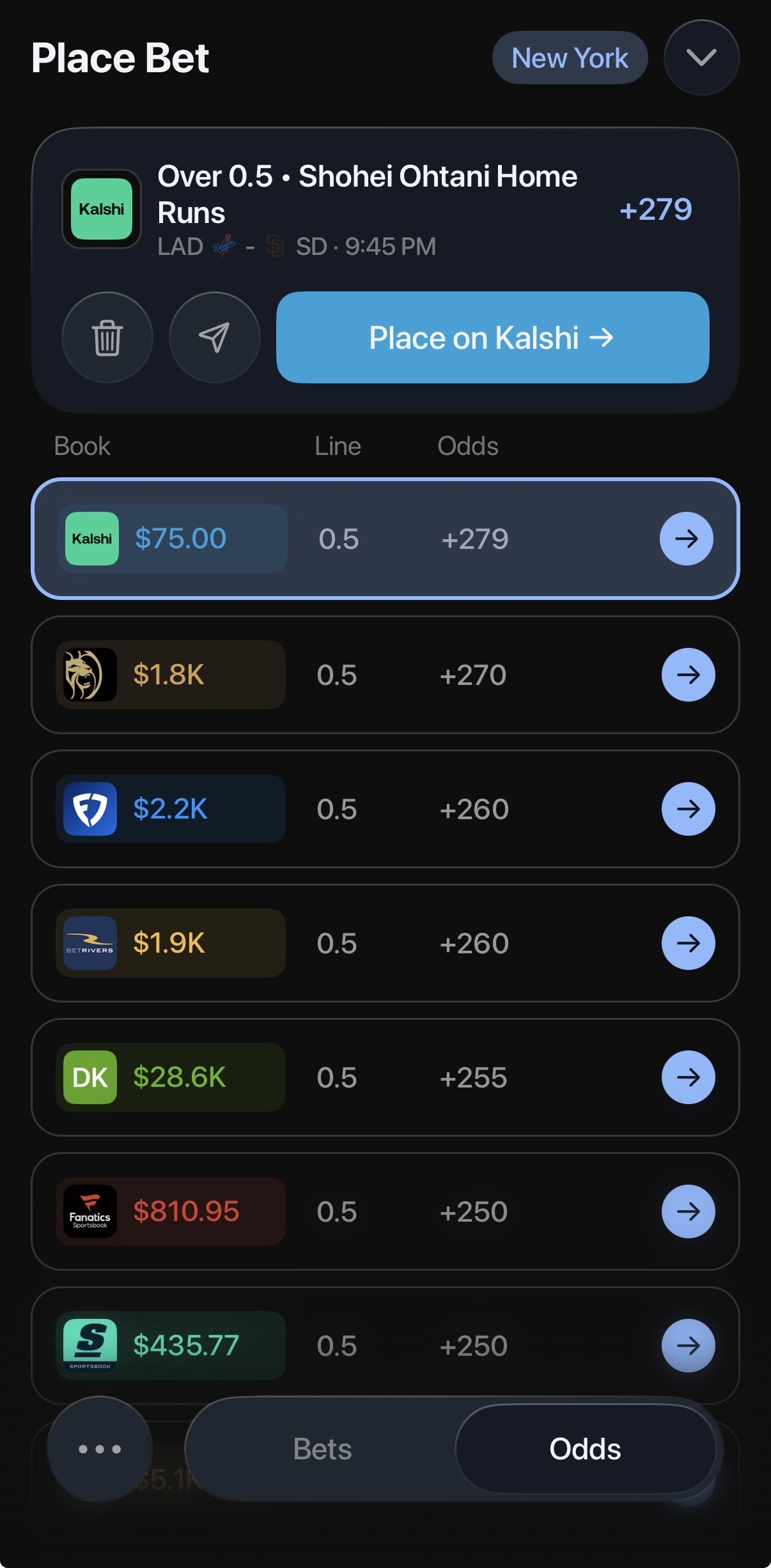
Second, tap Autofill and choose the book offering the strongest combined price.
Third, your sportsbook app opens with every leg pre-populated. You set your stake, confirm the current odds, and place.
The line shopping happens inside the build, not as a separate chore afterward. You construct the bet a single time and the price comparison comes for free. For a five-leg parlay that would take 90 seconds to rebuild manually at even one book, the whole find-the-best-price-and-place flow takes 5 to 10 seconds once the bet is structured. The connection runs through BookSync, which links your sportsbook accounts to Pikkit, so the same plumbing that compares the lines also tracks the bet after you place it.
One important note: Autofill never places the bet for you. It hands the pre-built slip to your sportsbook, and you review the final price and stake before confirming. You get the speed of one-tap building with the safety of seeing the real number before you commit.
Not every market rewards line shopping equally. Knowing where the spread between books is widest tells you where the minute is best spent.
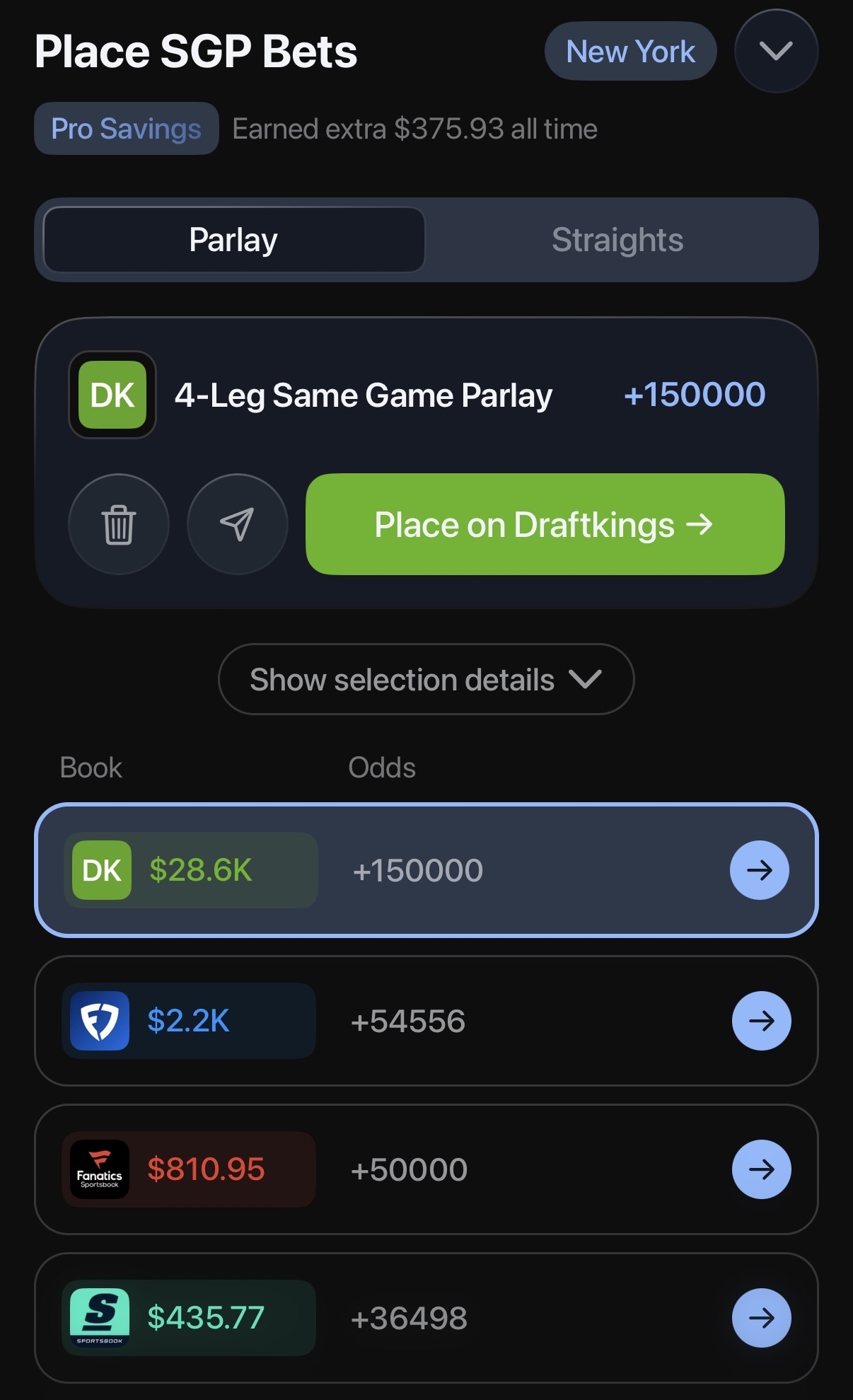
Same-game parlays show the largest gaps by far. Because each book prices the correlation between legs differently, the same SGP can be +650 at one sportsbook and +850 at another. That is not a rounding difference, it is a materially different payout on an identical bet. Building the SGP once and seeing every book's combined price before you commit is the clearest case for shopping. Cross-sportsbook SGP price comparison is a Pikkit Pro feature. Take a look at example of a large price gap on an SGP built within Pikkit's betslip.
Player props are next. Prop markets are thinner and move fast, so prices diverge more than on main markets and soft numbers get bet down quickly. The difference between catching a prop at -110 versus chasing it at -120 after it moves is the difference between a bet that profits long term and one that breaks even.
Main markets, the moneylines, spreads, and totals on big games, have the tightest pricing because they take the most action, but even there the five-cent and half-point edges are worth taking when they are sitting right in front of you.
Line shopping is the right move on nearly every bet, but a couple of honest caveats keep it useful rather than dogmatic.
Best for: Anyone placing multi-leg bets, props, or SGPs, where price variance across books is widest. Anyone betting volume, since the EV compounds with every wager. Anyone copying a bet from a feed, because the structure already exists and shopping it costs nothing extra.
Watch for: A best line you cannot actually bet. The strongest price is only useful at a book where you have a funded account, so the practical best line is the best number among your connected books, not a screenshot from somewhere you cannot wager. Watch too for chasing a price that has already moved. If the line shifted between building and placing, you will see the new number when your sportsbook app opens, and the right call is sometimes to pass rather than take a worse price than you planned.
A single five-cent edge is forgettable. A few hundred of them are not. The reason line shopping is treated as a foundational skill is that the gains accumulate quietly across every bet you place, and you only see the full effect when you measure it.
That measurement is the other half of the habit. When you place a bet through Autofill, it is tracked automatically in your bet tracker through BookSync, with your profit and loss, win rate, and return on investment updating in the background. No spreadsheet, no manual logging, no forgetting which book you used.
The metric that actually proves your shopping is working is closing line value. CLV compares the price you got to the closing price on the same market, and consistently beating the close is one of the few honest predictors of long-term profitability. A +120 bet that closed at +105 beat the market, regardless of whether it won. If you are shopping well, your average CLV climbs over time, and that is the number that tells you the minute per bet is paying off. Closing line value tracking is a Pikkit Pro feature.
The best betting line is rarely the one your main book shows you first, and the gap is real money over a season. The slow way to find it loses to the friction. The fast way is to build the bet once where every price is visible, take the strongest number, and let the tracking confirm you are actually capturing the value. That is line shopping in about a minute instead of five, on every bet instead of the occasional one you have patience for.
Download Pikkit to shop every connected sportsbook as you build and autofill your bet to the best price in one tap.
The best betting line finder is any tool that shows you live prices for the same bet across multiple sportsbooks at once, so you can take the strongest number. Pikkit does this inside the bet-building flow: as you build a slip, you see live lines from every connected book side by side, then autofill the finished bet to whichever sportsbook offers the best price. It is free and works across 30+ supported books.
The per-bet edges are small but compound. Saving roughly five cents of juice is worth about 2 to 3% in expected value on that bet, and a favorable half-point on a football spread is worth around 3%. Across the legs of parlays and dozens of bets a month, consistent line shopping can add 5 to 10% to annual return on investment without changing any of your picks.
Each sportsbook sets its own prices based on how its oddsmakers read the matchup and how much money is coming in on each side. Those small disagreements mean the same outcome is priced differently book to book. Sharper, higher-volume markets stay close together, while thinner markets like player props and same-game parlays vary the most.
Same-game parlays benefit most, because books price leg correlation differently and the same SGP can range from +650 to +850 across sportsbooks. Player props are next, since they are thinner and move quickly. Main markets like moneylines and totals have tighter pricing, but the five-cent and half-point edges are still worth taking when available.
No. Pikkit's Autofill sends the pre-built bet to your chosen sportsbook app, and you review the current odds, set your stake, and confirm the bet yourself. Pikkit never places wagers on your behalf. You get the speed of one-tap building plus the safety of seeing the final price before committing.
Track your closing line value. CLV compares the price you got to the market's closing price on the same bet, and consistently beating the close is one of the most reliable signs of long-term edge. Bets placed through Autofill are tracked automatically through BookSync, so your CLV, win rate, and ROI update without manual logging. Closing line value tracking is a Pikkit Pro feature.
For a single small straight bet, the few cents saved may not justify opening several apps manually. The point of building the comparison into the bet-building flow is that shopping costs you no extra time, so even small bets capture the better price. Over hundreds of bets, those small edges are where most of the long-term value comes from.


