.png)


Updated May 2026.
Baseball has more individual betting markets than any other major US sport. Every pitch is a potential betting moment, every at-bat has its own market, and the 162-game regular season gives bettors more nightly volume than the NFL produces in a full year. That depth is the appeal, but it also makes MLB the easiest sport to bet poorly if you don't understand what you're betting on.
This guide covers every major MLB bet type you'll see in a US sportsbook, what each one actually means, and where bettors most often go wrong on each.
A moneyline is the simplest bet in any sport: pick the team that wins the game outright. If the Dodgers play the Astros, a Dodgers moneyline cashes if they win, regardless of the final score.
Baseball moneylines run a wider range than other major sports because of how often plus-money underdogs win. In the NFL, a heavy favorite might be -800. In the NBA, you'll see -1500 favorites occasionally. In MLB, even the best team facing the worst team is rarely above -300 because the variance in baseball is so high. A backup pitcher catching fire or a bullpen blowing a lead can flip any game.
That variance is why moneylines are popular for sharp bettors. Plus-money dogs (+130, +160, +200) hit often enough that finding edge in those markets is a cleaner path to profit than betting heavy favorites and giving up huge juice.
The MLB version of a point spread is called the run line. Unlike football or basketball where spreads vary widely by matchup, MLB run lines are almost always set at -1.5 / +1.5. Baseball is a low-scoring sport, and the vast majority of games are decided by 1 or 2 runs, so the standard spread doesn't move much.
Where the value sits is in the juice. A favorite at -1.5 might be priced anywhere from -110 to +180 depending on how strong they are. The +1.5 underdog ranges from -130 to as low as -250. Bettors who line shop run lines across multiple sportsbooks consistently find 5-15 cent differences on the same game, which adds up over a full season.
The math to know: a team that wins by exactly one run pushes the run line if you bet the favorite at -1.5, but covers if you bet the underdog at +1.5. Roughly 25-30% of MLB games are decided by one run, so the +1.5 underdog hits more often than people expect.
You'll occasionally see a -2.5 / +2.5 line when there's a massive talent gap, but those are rare and usually reserved for matchups featuring the league's worst teams against contenders.
Totals work the same way they do in any sport: the sportsbook sets a number for total combined runs, and you bet whether the actual total will be over or under that number.
MLB totals typically range from 6.5 to 11.5 depending on the matchup. The factors that move totals include starting pitcher quality, bullpen strength, ballpark dimensions, weather (wind direction matters more in baseball than any other sport), and umpire tendencies on the strike zone.
You can also bet team totals; the over/under on just one team's runs. If you think one team will do most of the scoring in a 9.5-total game, taking the home team over 5.5 and the away team under 4 separately can offer better value than just playing the full-game total.
First 5 bets, often shortened to "F5," are unique to baseball. They settle based on the score after the first 5 innings only, before bullpens take over and games get unpredictable. F5 bets come in three flavors: moneyline, run line, and total.
The appeal: you're betting on starting pitchers, not bullpens. Starters are the most predictable element of any baseball game. If you've done the work on a pitcher matchup and like one team's starter, F5 bets let you cash in on that edge without exposing yourself to bullpen variance.
There's an important wrinkle to know about. Sportsbooks grade F5 bets differently:
Even-innings books treat F5 as the first 5 full innings, where both teams get the same number of at-bats (5 each, assuming the home team takes their at-bats in the bottom of the 5th).
Mid-game books grade F5 at the exact halfway point of the 9-inning game, which is the middle of the 5th inning - meaning the home team gets one fewer chance to score. The juice on these lines reflects that asymmetry, so always check your sportsbook's house rules before placing F5 bets.
Same-game parlays (SGPs) have exploded as a bet type in MLB over the last few seasons. Most major US sportsbooks now offer SGPs across MLB props, allowing you to combine selections from a single game into one parlay. An example would be; a starter to record over 6.5 strikeouts, the team to win, and the game total under 8.5, all bundled into a single bet.
The math on MLB SGPs is more interesting than other sports because of correlation. A pitcher who racks up strikeouts is also a pitcher who keeps runs off the board, which means "Pitcher over 7.5 K's + game under 8.5 total runs" is a correlated SGP. Both legs are more likely to hit together than independently. Sportsbooks know this and adjust the price accordingly, but the pricing isn't always perfect.
The downside: SGP juice is steep. Standard 3-leg same-game parlays often carry 15-20% in built-in vig, compared to 4-9% on individual bets. Track your SGPs separately from your other bets through your parlay tracker so you can see whether you're actually making money on them or just enjoying the occasional payout while the math runs you over the long term.
Baseball's player prop market is the deepest in US sports. Pitchers and hitters each have their own prop categories, and most games offer 50+ individual prop markets across both teams. The three biggest are strikeout props, hits props, and total bases props.
Home run props are the most popular MLB prop market, and it's not particularly close. The combination of plus-money odds, a single binary outcome, and the visceral thrill of watching a swing leave the yard makes them the gateway prop for casual bettors and a serious market for sharps. A typical "yes" on a hitter to hit a HR ranges from +300 to +800 depending on the player and matchup, which is why this market drives so much volume across every US sportsbook.
The standard market is "Player to Hit a Home Run - Yes/No," priced from +300 for an elite power hitter in a friendly matchup out to +800 or worse for contact hitters in tough spots. You'll also find a deep set of related markets:
The factors that move HR prop pricing are different from other markets. The signals to read:
The math is sobering for casual HR bettors. Even +500 odds need to hit roughly 17% of the time to break even, and most hitters - even prolific ones - go yard in fewer than 10% of their games over a season. Picking the right matchups matters more here than in any other prop market.
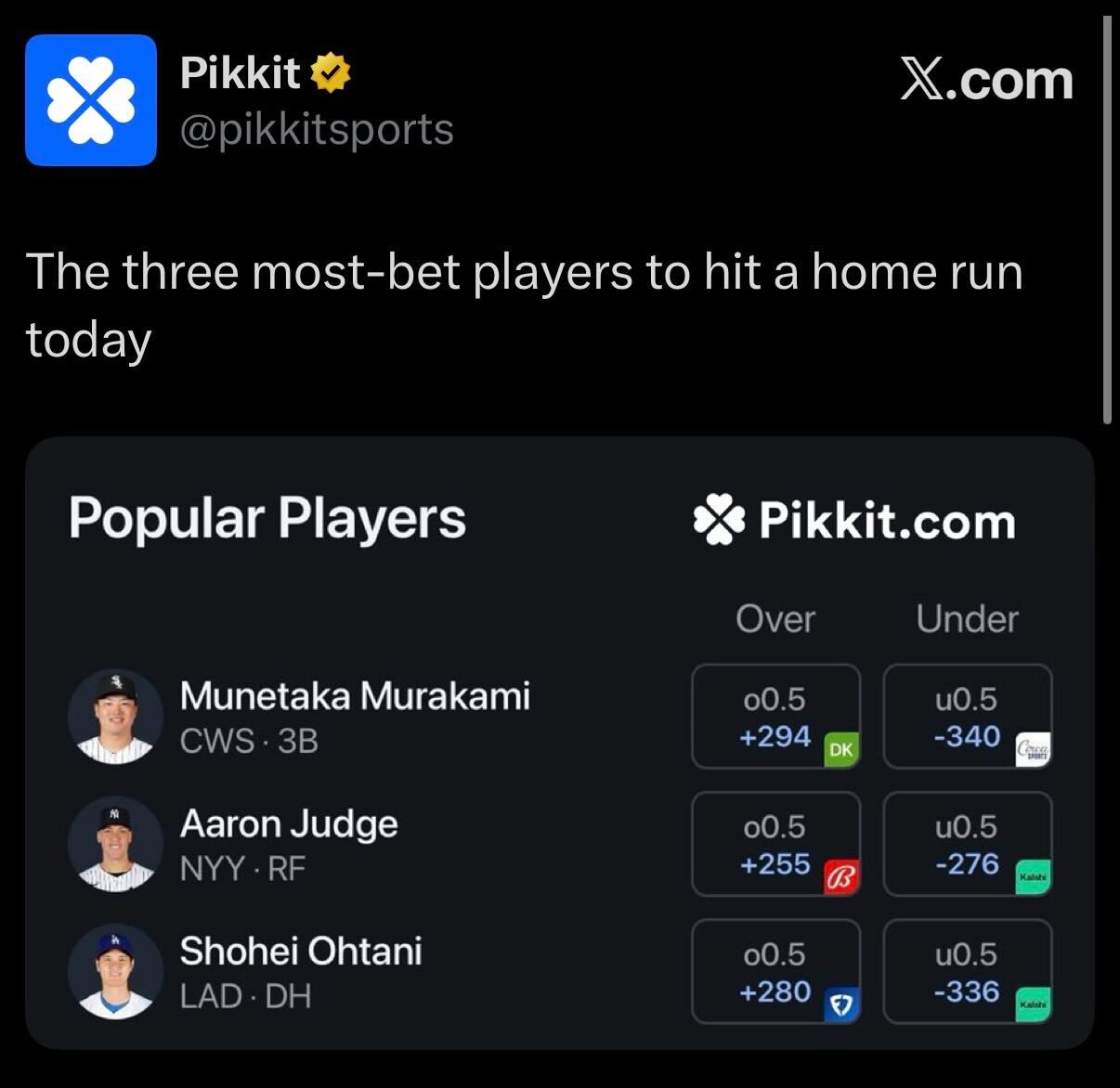
This is exactly why we cover home run picks daily across Pikkit's social channels. Follow Pikkit on X to see the most bet HR players every single day. Here's what it looks like!
Strikeout props focus on how many strikeouts a starting pitcher records in their outing. Lines typically run from 4.5 to 9.5 strikeouts depending on the pitcher, opposing lineup, and ballpark. The sharp factors that go into a strikeout line:
Strikeout props are low-volume markets, meaning a half-strikeout difference is significant. The gap between an over 6.5 line and an over 7.5 line is roughly a 15% swing in implied probability. Line shopping on strikeout props is one of the highest-EV things you can do as a baseball bettor.
Hits props like "Will Aaron Judge get a hit today?" - are one of the other highest-volume offensive prop market. Lines are almost always 0.5 or 1.5, occasionally 2.5 for elite hitters with a soft matchup. You'll typically see one-way lines as well labeled 1+, 2+, or 3+ instead of the O/U market.
The challenge: even the best hitters in baseball fail to record a hit in roughly 70% of plate appearances. With only 3-4 at-bats per game on average, the margin between hitting and not hitting is razor-thin and largely a coin flip in any individual game.
That's why hits props at 0.5 carry heavy juice. A line at -180 means the sportsbook is pricing in a roughly 64% probability that the hitter records at least one hit, which is realistic for most starters. The implied edge is small, and most casual bettors lose money on this market without realizing it.
Total bases props give bettors a deeper version of the offensive prop. Instead of just hits, you're betting on the bases recorded across a player's at-bats: a single is 1 base, double is 2, triple is 3, home run is 4.
The advantage over hits props is that singles, doubles, and home runs all contribute. A line at over 1.5 total bases is roughly equivalent to "two hits OR one extra-base hit," which gives bettors more paths to a winning ticket than a 1.5 hits prop would.
Important to know: total bases only counts bases earned during at-bats. Walks, hit-by-pitches, and stolen bases don't count toward the prop. Errors that put a hitter on base also don't count. The market is strictly tied to hits.
Beyond the four core markets above, you'll find:
These secondary markets often carry more juice than primary props but can offer value when sportsbooks haven't sharpened the line.
Baseball's pace makes it one of the best sports for live betting. Lines update between every inning, every pitcher change, and after every significant moment in the game. Live moneylines, run lines, totals, and inning-specific markets are all available.
The sharp angle on MLB live betting: bullpen quality is often mispriced after a starter exits. If a strong starter pulls his team to a 4-run lead through 6 innings, but the bullpen behind him is bottom-5 in the league, the live moneyline often doesn't fully account for that bullpen risk. Conversely, when a weak starter gets pulled early but a team has a dominant bullpen, the live odds can offer value the other direction.
Track your live MLB bets carefully through BookSync. Live betting is where bettors can leak money the fastest because of the rapid pace and emotional decision-making.
Futures are season-long bets that resolve at the end of the season or playoffs. The major MLB futures markets:
Futures tie up your bankroll for months, which is the trade-off for the typically larger payouts. Best practice: limit futures to a small percentage of your bankroll (1-2% per future is conservative; 5% maximum on a single bet) and consider hedging toward the end of the season if your futures are still live.
MLB's 162-game season generates more individual bets than any other sport. Without a bet tracker, it's almost impossible to know which bet types are actually profitable for you. Maybe your run-line bets are net-positive but your strikeout props are dragging your overall ROI down. You won't know until you track them separately.
Pikkit syncs to 30+ sportsbooks via BookSync and breaks down your performance by bet type, sport, market, and sportsbook. Every MLB bet you place is logged automatically, with full leg detail on parlays and SGPs.
Download Pikkit to start tracking your baseball bets.
A moneyline bet is just on which team wins the game. A run line bet (the baseball spread) is on whether a team wins by 2 or more runs (-1.5) or loses by less than 2 / wins outright (+1.5). The run line offers better odds on favorites and worse odds on underdogs compared to the moneyline.
F5 stands for "First 5 innings." It's a bet that settles based on the score after the first 5 innings only, isolating the starting pitcher's performance from bullpen risk. F5 bets are available as moneylines, run lines, and totals. Always check your sportsbook's grading rules - some books grade F5 at the end of the 5th inning, others at the exact halfway point of the 9-inning game.
Sometimes, but the juice is significant. Standard MLB SGPs carry 15-20% in built-in vig compared to 4-9% on individual bets. Correlated SGPs (where the legs reinforce each other, like "pitcher over Ks + game under total") can offer real value when priced loosely, but most casual SGPs are heavily juiced. Track them separately from your other bets to see whether you're actually winning.
The moneyline is the simplest and most intuitive starting point. From there, totals (over/under runs) are the next easiest to learn. Beginners should generally avoid heavy juice props (-200 or worse) and same-game parlays until they've built up at least a few hundred tracked bets and understand their ROI by bet type.
Strikeout props are low-volume markets where small line differences make a big impact. The gap between a 6.5 line and 7.5 line is roughly 15% in implied probability, so finding an extra half-strikeout in your favor is meaningful. Line shopping across multiple sportsbooks is one of the easiest ways to add EV to your strikeout prop bets.


