.png)


A sports prediction market lets you trade on game outcomes against other people instead of against the house. Rather than taking the odds a sportsbook sets, you either accept a price another user has posted or post your own and wait for someone to take the other side. ProphetX is the sports-native version of that model, a CFTC-regulated prediction exchange that trades event contracts on sports and is now live across nearly the entire country. The reason bettors are moving to it comes down to five things: sharper pricing, no limits on winning accounts, nationwide access, the ability to set your own prices, and a commission that only applies when you win.
This guide explains how the prediction market model actually works, why the economics differ from a traditional sportsbook, and where the tradeoffs are. If you want the current ProphetX welcome offer first, the prediction market bonuses page tracks it.

A sports prediction market is a marketplace where people trade contracts tied to the outcome of a game. Each contract pays out a fixed amount if the outcome happens and nothing if it does not, so its price moves with the market's view of how likely that outcome is. The platform does not set the odds or take the other side of your position. It matches buyers and sellers and takes a small cut of the winners.
Every trade has two sides. You can back an outcome, which means taking the position that it happens. You can also lay an outcome, which means taking the other side and trading on it not happening. When you lay the Chiefs to win, you are effectively acting as the house for whoever is backing them. Someone has to be on each side for a trade to fill, so a price you post is not live until another user matches it.
The mental model that fits best is a stock exchange for game outcomes. Buyers and sellers meet at a price, orders fill when they agree, and the platform earns a commission rather than a built-in margin on every ticket. ProphetX runs this model on sports and settled its regulatory status in June 2026, which is covered in more depth in ProphetX goes nationwide.
One distinction matters here. Some prediction markets, like Kalshi and Polymarket, trade contracts across politics, finance, weather, and entertainment. ProphetX is sports-native, meaning it was built specifically for sports contracts rather than adding sports on top of a general platform. That focus is why its markets and pricing behave more like a sports betting exchange than a general prediction market.
Here is a look at ProphetX's platform. It looks just like a traditional sportsbook.
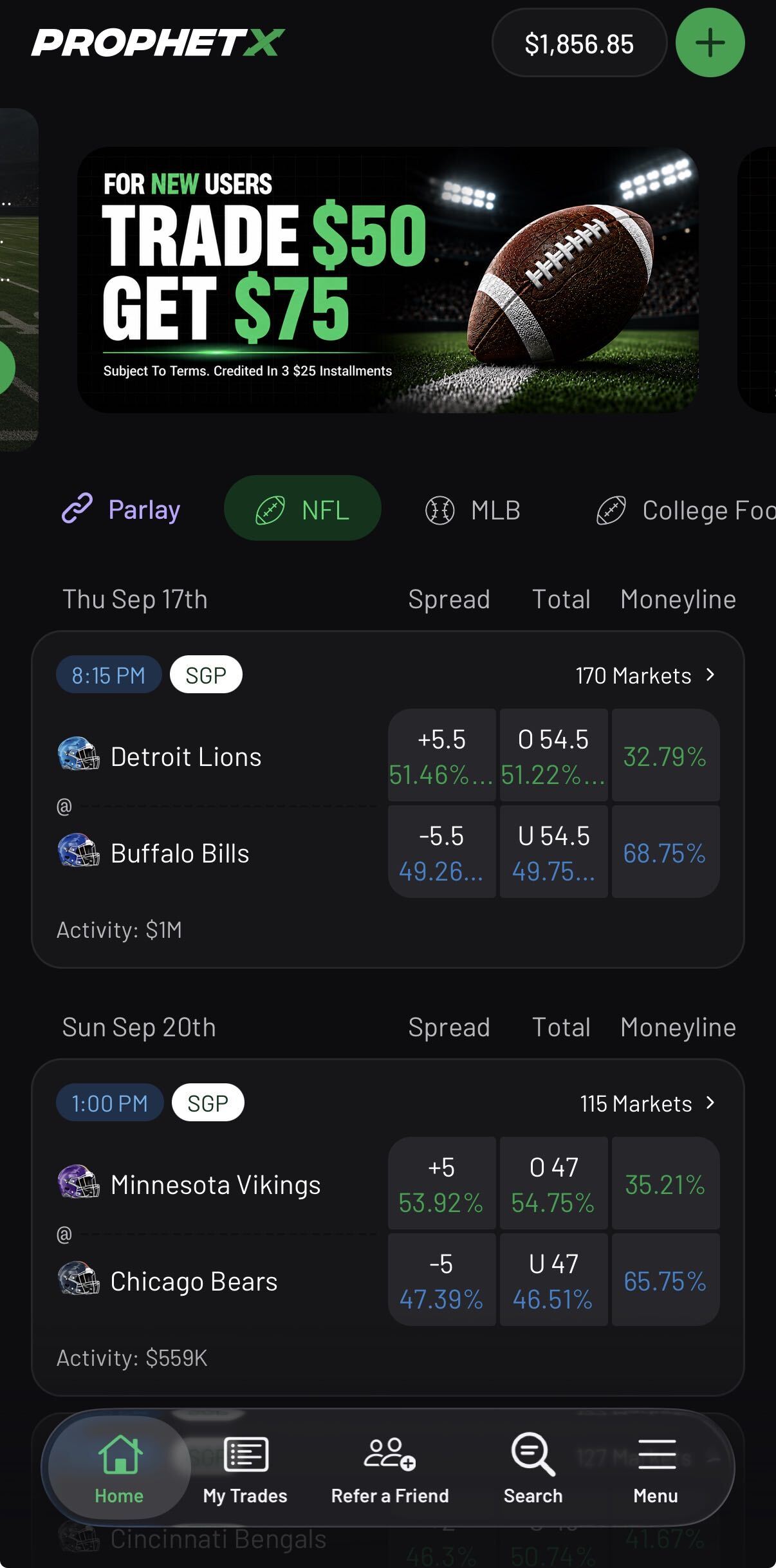
The core difference is who you are trading against so that changes where your money goes.
At a sportsbook, you bet against the house. The book sets the odds, takes the opposite side of your wager, and builds a margin into the price. That margin is the vig. It is why a true coin-flip market is priced around -110 on both sides instead of +100. Whether you win or lose, the vig was already baked into the number you took.
On a prediction market, you trade against another user, and the platform charges a commission only on your net winnings. There is no margin sitting inside the price. The practical result is that prediction market prices can sit closer to the true probability, because nobody is padding the line to guarantee a house edge on both sides. A sportsbook profits when its customers lose. An exchange profits from the volume of trading itself, which is a very different alignment.
Pricing is the headline reason to use a prediction market. Consider a game total priced at -110 on both the over and the under at a sportsbook. To bet $100 to win $100, you actually have to risk $110, and the extra $10 is the book's built-in edge. On a prediction market, the same market can trade closer to even money on both sides, because the platform is not holding either side. You are matched against another user who disagrees with you, and the price reflects where you meet rather than where the book wants its margin.
Over a single trade the gap looks small. Over hundreds of trades, consistently getting a price a few cents better compounds into real money. The clearest way to see whether you are capturing that value is closing line value: whether the price you got beat where the market settled. A position taken at +120 that closed at +105 was a good trade regardless of the result, and a prediction market gives you another reference point for judging the number you took.
Traditional sportsbooks make money by keeping the vig, so a bettor who wins consistently works against that model. Books protect themselves by limiting accounts, sometimes to a few dollars per bet, which quietly ends your ability to bet at meaningful stakes.
A prediction market does not have that conflict. ProphetX earns its commission on the volume flowing through the marketplace, not on whether any individual wins or loses. Because you are matched against other users rather than the house, winning does not put you at odds with the platform, so there is no incentive to cap a winning account.
Best for: anyone who has been limited or restricted at a sportsbook and wants to keep placing full-size positions.
Watch for: liquidity still governs how large a position you can get filled. The absence of account limits does not mean unlimited size on every market, since a trade only fills when another user takes the other side at your price.
ProphetX operates in nearly every state, with a small number of exceptions such as Nevada. That reach exists because of how it is regulated.
On June 11, 2026, the Commodity Futures Trading Commission cleared ProphetX to operate as a Designated Contract Market and a Derivatives Clearing Organization. In plain terms, it is regulated at the federal level as a financial exchange rather than as a state-licensed sportsbook, and that dual approval lets it trade, clear, and settle its own contracts in house. A traditional book has to be licensed state by state. Federal approval does not follow that map, so the exchange can operate almost everywhere at once.
For people in states that never legalized online sportsbooks, this is the part that matters most. States like California and Texas have no legal online sportsbook, yet the exchange operates in them. The prior alternative there was often an unregulated offshore site with no real recourse, so a federally regulated prediction market is a materially different option.
Best for: people in states with no legal online sportsbook, and anyone who wants a federally regulated alternative.
Watch for: the legal landscape for prediction markets is still developing, and the exact state list can change. Confirm current availability where you are before you deposit.
On a sportsbook you take the price you are given. On a prediction market you can set it.
If you think the Chiefs should be -130 and the market is showing -145, you can post an order at -130 and wait for someone to take it. You are acting as a market maker, naming the number you are willing to trade at. If another user agrees, the trade fills at your price rather than the book's. This works pre-game and live in play, across the major markets in football, basketball, hockey, and soccer.
That flexibility cuts both ways. Setting a better price for yourself means waiting for someone to accept it, and a limit order that never gets matched is a position that never opened.
Best for: people who have a specific read on where a line should sit and are willing to wait for a fill.
Watch for: unmatched orders do not become trades. If you need to be in the market at a specific time, taking an existing price is faster than posting your own.
The commission is where the prediction market model makes it's money. It works very differently from traditional vig.
ProphetX charges a commission on net winnings only. If a trade loses, you pay nothing beyond the stake you risked. If you post an order that never matches and you cancel it, you pay nothing. The fee applies solely to profit on winning trades. Reporting around the launch puts it at roughly 2% on winning straight positions like moneylines, spreads, and totals, with parlays carrying no commission at all.
Here is why "on net winnings only" matters. Say you back an outcome for $100 at even money and it wins, returning $100 in profit. A 2% commission takes $2 of that profit, leaving you $98. Compare that to a sportsbook, where the -110 price meant you risked $110 to win $100, and that cost applied whether the bet won or lost. On the exchange, a losing trade costs you the stake and nothing more, because there is no commission on a loss.
Parlays work a little differently on ProphetX. It uses a Request for Quote system that lets you build a multi-leg parlay and have counterparties price it directly, and those parlays currently carry no commission. That is a meaningful edge for anyone who likes multi-leg tickets, since a sportsbook stacks its margin on every leg.
Best for: people placing straight positions who want the cost tied to results, and parlay players who want to avoid the compounding margin a sportsbook charges.
Watch for: commission still eats into a winning bettor's returns, and the rates are newly set after the June 2026 approval. Confirm the current fee schedule on ProphetX before you trade.
The one real weakness of the prediction market model is liquidity. It's something worth understanding before you move all your action over.
A prediction market only works when someone takes the other side. In the major markets, moneylines, spreads, and totals on popular games, trading is deep and orders fill quickly at competitive prices. In niche markets and some player props, far fewer users are trading, so an order can sit unmatched or fill at a worse price than you wanted. A sportsbook always quotes a price on an obscure prop because it makes the market itself. An exchange cannot manufacture a counterparty that is not there.
The takeaway is to treat the prediction market as strongest where the volume is. For a Sunday NFL spread, the pricing edge is real and the fills are fast. For a deep player prop on a Tuesday night, a traditional book may still be the more reliable place to get the position down.
Best for: high-volume markets where deep two-sided trading keeps prices tight.
Watch for: thin markets, where the lack of a counterparty can leave you unmatched or force a worse fill.
ProphetX gives an explanation of liquidity right in their app if you need a better understanding.

Signing up for ProphetX looks very similar to opening up a sportsbook. As they are a prediction market, they have done a great job of making the experience tailored to a sportsbook one. Expect an identity verification step, including your name, address, date of birth, and the last four digits of your Social Security number, before you can trade. That is standard for a CFTC-regulated platform.
Once you are trading, the mistake most people make is judging the exchange by feel. Prediction market pricing looks cheaper because there is no visible vig, but the only way to know whether it beats your sportsbook results is to track both in one place. Pikkit's BookSync pulls your ProphetX trade history straight into your bet tracker automatically, then splits your results by platform so you can compare exchange and sportsbook performance side by side. The step-by-step guide to syncing ProphetX to Pikkit walks through the one-minute setup.
The pricing edge and the missing account limits are real advantages. Whether they translate into a better bottom line for you is the part only your own tracked numbers can settle.
Download Pikkit to sync ProphetX and track every bet across all your books in one place.
A sports prediction market is a marketplace where people trade contracts tied to game outcomes against each other instead of against a sportsbook. Each contract pays a fixed amount if the outcome happens and nothing if it does not, so its price reflects the market's view of the probability. The platform matches the two sides and charges a commission on winnings rather than building a margin into the odds. ProphetX is a CFTC-regulated sports prediction exchange that runs this model.
A sportsbook sets the odds, takes the other side of your bet, and bakes a margin called the vig into the price. A prediction market matches you against another user and charges a commission on your net winnings instead. Prediction market prices can be sharper because there is no house margin, but your order only fills when another user takes the opposite side.
ProphetX charges a commission on net winnings only. Reporting around its launch puts the rate at roughly 2% on winning straight positions like moneylines, spreads, and totals, with parlays carrying no commission. You pay nothing on losing trades or on orders that never match, so the cost is tied to profit rather than baked into every price.
Both terms describe the peer-to-peer model, but ProphetX is regulated and marketed as a sports prediction exchange rather than a traditional betting exchange. It trades CFTC-regulated event contracts on sports, which is what allows it to operate nationwide as a federally regulated exchange instead of a state-licensed sportsbook. The trading experience is similar to an exchange, but the legal structure is that of a prediction market.
ProphetX operates in nearly every state as of mid-2026, with a small number of exceptions such as Nevada. It runs as a CFTC-regulated prediction exchange rather than a state-licensed sportsbook, which is why it is live even in states with no legal online sportsbook, such as California and Texas. Because the legal landscape for prediction markets is still developing, confirm current availability before you deposit.
Backing an outcome means taking the position that it happens, the same as a normal bet. Laying an outcome means taking the position that it does not happen, which puts you on the side a sportsbook would normally take. If you lay a team to win, you profit if it loses or ties and you pay out if it wins. Every matched trade has one user backing and one laying.
The main downside is liquidity. An exchange only works when another user takes the other side, so major markets like moneylines and spreads trade deeply while niche markets and some player props can be thin. A thin market can leave your order unmatched or fill it at a worse price than a sportsbook, which always quotes a price because it makes the market itself.
Yes. Pikkit's BookSync connects to ProphetX and imports your full trade history automatically into your bet tracker, then keeps it updated as trades settle. Pikkit splits results by platform, so you can compare your prediction market performance against your sportsbook betting directly and see whether the sharper pricing is actually improving your bottom line.


